Saturday, February 26, 2022

Dog


Co-directors Reid Carolin and Channing Tatum take famliar and bankable formulas -- the buddy picture and the road movie -- and tweak them to fit Tatum's ebullient, mouthy strut and remind viewers of the walking wounded among us.


In Dog, Tatum is cast opposite a Belgian Malinois, and they both play Army Rangers traumatized by duties in the Middle East. They are on a five-day trip to attend the funeral of another Ranger, the dog's handler and Tatum's squadmate who had just killed himself by driving into a tree.


Tatum's sidelined and battle-scarred Briggs is offered the deal of transporting the seemingly unconrollable Lulu from Oregon to Arizona in exchange for another paid assignment, despite doctor's warnings that his head injuries, for which Briggs is being treated, are debilitating. After Lulu attends the funeral, Briggs is to turn her over to the Army to be destroyed.


As one might expect, the story is told episodically and reveals pieces of what Briggs and Lulu have lost in service to their country. The film, which is pretty entertaining, plays to Tatum's strapping boyishness but never lets us forget that his character is not a well man. The picture doesn't always maintain its equilibrium but it never falls into pandering or ridicule.

The Falcon and the Winter Soldier


Marvel Studios routinely blends heroism and vulnerability in its characters but its treatment of the ambivalence Sam Wilson / Falcon (Anthony Mackie) initially feels about assuming the role of Captain America, a post nearly everyone but Wilson sees he is supremely suited for, is exceptionally well-done, even if the last episode gets a little preachy.

In The Falcon and the Winter Soldier, the usual fight-and-flight superhero plotting is enhanced by references to America's racial history, personoified by Carl Lumbly's Isaiah Bradley, a Black man used for super-soldier experimentation and then abandoned. (Echoes of the Tuskegee Experiments are surely not accidental.)

Bradley's resentment and Wilson's anxiousness mixed with the elevation of a "fair-haired boy," a traumatized Afghan veteran played by Wyatt Russell, to be the new Captain America converge into a compelling statement about truth and legitimacy.

Underpinning all of this are the increasingly dangerous actions of a racially diverse, globe-trotting band of amped-up, disaffected youths pushing for world change. Who is best suited to respond to the threat?

The series' white characters are neither rabid racists nor woke warriors. Everyone seems to be a work-in-progress -- another characteristic to be found in the best of the Marvel Universe features. This is especially true of Bucky Barnes / Winter Soldier.

An important, albeit brief, exchange comes in the final episode when Barnes apologizes to Wilson for pressing him to step up, not understanding what it would mean for a Black man to take up Captain America's shield (literally and figuratively). This felt like a genuinely healthy exchange between friends/co-workers/partners. Sometimes all it takes is owning one's ignorance.

Marvel fans will know Barnes' character has a special affinity with Black characters, having been treated and protected in Black Panther's Wakanda, where he was known as White Wolf. Because of his long residence in that African nation, he was, as the saying goes, "invited to the barbecue," where he was shown along with Wilson's family and friends at the episode's end.

Licorice Pizza


True to form, Paul Thomas Anderson's latest film Licorice Pizza blends exactness with surrealism in its depiction of a visionary schemer (and / or scammer) in his habitat.

Anderson's period and subject is early '70s Southern California where a 15-year-old entrepreneur and actor named Gary Valentine (Cooper Hoffman, son of the late Philip Seymour Hoffman), of Sherman Oaks, convinces an aimless and angry young woman named Alana Kane (Alana Haim) to join him in a few misshapened money-making opportunities (selling waterbeds, opening a pinball arcade), with the unspoken assumption that one day she would disrobe.

Young Gary joins the ranks of Anderson's other great minds -- the porn producer of Boogie Nights (1997), the petroleum prospector of There Will Be Blood (2007), the conniving conman of The Master (2012), the fashion fetishist of Phantom Thread (2017) -- but Gary's obsessions don't lead to ruin or madness. He realizes chasing a dream often leaves one wondering what is to be done with the dream once caught. Maybe life's true joy is in the chase. An important consideration.

Alana's journey is as important as Gary's as she commandeers his plans to keep them on the rails. She discovers a lot about her own capacities, separate from the alienating expectations of her family or her semi-employed friends or the false idols she's erected to give the world meaning. Alana's brashness gives the picture its spark, her brittleness its heart.

Licorce Pizza takes its name from a chain of California record stores and the film itself features an abundance of Nixon-era AM radio hits.

Tuesday, February 8, 2022

Best Picture 2022


FWIW, this year's Best Picture Oscar nominations feel mostly right to me.


BELFAST -- Warm and affectionate movie directed by and featuring British film royalty, both nominated along with the director, Kenneth Branaugh. Strong story. Leads weren't nominated. Won't win.

CODA -- Jagged, unapologetic and emotive film that features deaf actors (one nominated) as central players. Touching and affirming. Won't win.

DON'T LOOK UP -- Smart-ass message movie lousy with Hollywood A-listers and a killer ending but an unrelentingly condescending tone. Won't win.

DRIVE MY CAR -- Little-seen, foreign-language film based on a story by a contemporary literary master, Haruki Murakami. Dunno. Haven't seen it.

DUNE -- Technically spectacular re-crafting of an impossible story. No acting nominations. And the director wasn't nominated. Won't win the big prize.

KING RICHARD -- Will Smith-produced story of the exceptional, though flawed, man who groomed two tennis champions. Smith might win, he's overdue. His co-star Anjanue Ellis is also nominated for several strong scenes and holding her own with Smith's imposing on-screen presence. Picture won't win.

LICORICE PIZZA -- So much works about this picture even when the audience feels they've wandered into madness. But that's Paul Thomas Anderson -- as distinctive a cinematic vision as any. Neither of the leads is nominated. The script crackles but the movie won't win.

NIGHTMARE ALLEY -- Beautiful homage to film noir. Visually splendid but director Guillermo del Toro was not nominated, oddly, nor was any of the cast. Won't win.

THE POWER OF THE DOG -- Everything works in this picture. Story, performances and scoping. Four acting nominations, including Jesse Plemons, who was overlooked for the Globes. And Jane Campion is nominated for directing. Almost a sure thing.

WEST SIDE STORY -- It's got Spielberg, a star-making supporting performance from Ariana DuBose, and is wonderful in the moment but, weirdly, has little staying power. Won't win.

Monday, January 31, 2022

Parallel Mothers


Pedro Almodóvar's Parallel Mothers unfolds like a flower, revealing the uncertainty and complexity of its characters' lives. The mothers of the title -- Janis (Almodóvar's longtime collaborator Penélope Cruz) and Ana (new face Milena Smit) -- meet in a Madrid hospital where they are both about to deliver their first child. Janis, the almost-40-year-old fashion photographer, is jubilant with anticipation; Ana, a disaffected and alienated teenager, is not. They bond and enter single motherhood the better for having met ... at first.
As is his practice, Almodóvar folds into this already rich story of human (dis)connections socio-political elements that extend the film's message beyond the intimate to the universal. This time, the subplot involves Janis's grandfather, who was executed by Francoists and tossed in a mass grave with other anti-fascists. Janis enlists the help of a handsome archaeologist (Israel Elejalde) to exume the remains so that family members might bury them properly. This leads to personal entanglements.
Cruz's Janis is the emotional center of Almodóvar's film of two mothers, but Smit's Ana, a needy and dyspeptic character, no longer a child and not quite woman, is an intriguingly hazy mass of conflicted emotions and raw need. Her distress meshes well with Janis's own.
As provocative as Almodóvar enjoys being on behalf of people and causes close to him -- particularly LGBTQ+ rights -- the story of these two women feels uniquely of the moment, as societies clash in so many corners about women's liberty and threats to their freedom to choose their own happiness.

Wednesday, January 26, 2022

A Man Named Scott


Robert Alexander's documentary on hip-hop entertainer and actor Kid Cudi, A Man Named Scott (2021), is a highly affecting film. It is intriguing because Cudi, birth name Scott Ramon Seguro Mescudi, is so engaging as he and his collaborators describe his creative process, the substantial impact his musical vision has had on millennial culture, and the nearly crippling depression he's battled much of his adult life.

Cudi's emergence as a creative innovator tracks along with changes in the recording industry, which maddingly embraces both the "sure thing" and the "change agent" and wages fierce battles to contract and control bankable artists. Cudi attributes the success of his experimentalism to tapping into emotional veins that other rappers were either ignorant of or chose not to acknowledge. This left Cudi as a singular voice speaking to uncertainty and despair, feelings his listeners connected with.

Counted among his fans are celebrity friends who appear in the film, Shia LaBeouf, Jaden and Willow Smith, Timothée Chalamet, and, of course, Ye (formely Kanye West). His fans followed him devotedy through his musical explorations, they say, because his words never failed to be salient and important.

Alexander's film, his first documentary as a director, is artfully constructed, going beyond the usual interviews and file footage of concerts or recording sessions to incorporate theatrical performances that illuminate Cudi's narrative. It's a beautful and important work.

The Tender Bar


George Clooney's The Tender Bar takes a familiar coming-of-age story (based on the memoir by J.R. Moehringer) and turns it into a rumination on the people and events that give our lives structure by their presence and their absence.

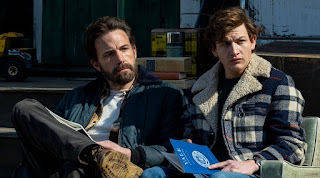
Tye Sheridan plays J.R., a young man who has grown up on Long Island under the watchful eye of his mother (Lily Rabe) and with the loving tutelage of her brother, his Uncle Charlie, played with wonderful ease and enormous charm by Ben Affleck (in top acting form). They are all living with J.R.'s grandparents (Christopher Lloyd and Sondra James) in a clapboard house that's barely large enough to hold them and the various aunts and cousins who use it as a port during life's frequent storms. They're a loving, unkempt, directionless mess.

Uncle Charlie owns a bar, The Dickens, and is as schooled in the ways of the world (and man science) as anyone, due primarily to his voracious appetite for great books. He pushes young J.R. (played as a boy by the impressive child actor Daniel Ranieri) to read, which inspires the chronically indecisive boy to set his sights on being a writer.

J.R. gets a scholarship to Yale, falls badly in love, establishes a lifelong friendship but carries around the weight of his absent father (Max Martini), a radio D.J. who abandoned the family shortly after J.R.'s birth and only appears or calls to assure and disappoint. This is something J.R. must be rid of before he can move on.

Clooney is adept at bringing his players into close proximity, in spaces where they exchange intimacies, soft lies and hard truths. Every barstool wise-crack, callow insensitivity or naive reveal feels real. And that's the picture's true strength, despite some unevenness in character development and narrative flow, it feels really authentic.

Monday, January 17, 2022

Scream (2022)


Scream (2022) pulls off a pretty neat parlor trick. It tells the audience exactly what it's doing, what the franchise and other similar slasher movies have done, reunited surviving members of the legacy cast, winked at the audience of fankids who are WAAAAAAAYYY too smart for their own good, revealed the ending long before it arrived and STILL was able to deliver genuine jolts and surprises. Well done!

Belle (2021)


Japanese director / animator Mamoru Hosoda's lavish Belle (2021) is the umpteeth retelling / recasting of the Beauty and the Beast fairytale, set both in an enormous virtual world called "U", over which a beautful singing avatar named Belle rules, and in actual southern Japan, where a withdrawn high school student named Suzu seems to be losing the struggle with adapting to her mother's death years before. How these two worlds rise and converge is the gist of the story, whose pacing is more deliberate than game-based anime but which succeeds with a thoughtful storyline and characters that have more dimensions than one might expect in an animated feature. I regret the dubbed version of the film and not the original Japanese with subtitles was screened at my showing. I prefer seeing and hearing the product as the director had intended.

Monday, January 10, 2022

The 355


Simon Kinberg doesn't deliver much that's new for the super-spy genre in The 355. Even its central premise of a team of international female "bad asses" teaming up to avert global catastrophe by retrieving a device that could subvert and control the cybersphere doesn't feel especially fresh. The same "ladies get it done" swagger we've been seeing for decades.
The picture -- which stars Jessica Chastain, Diane Kruger and Lupita Nyong'o as American, German and British assets, respectively, along with Penelope Cruz as a Colombian psychotherapist to spies and Bingbing Fan as a Chinese double (triple) agent -- delivers some good thrills but two or three set pieces that go too long for the punch they pack. A bit more story (more about what drives these women), less close-quarter fighting (it all becomes a blur) and one or two fewer double-crosses (secret agencies cannot be that porous) would have greatly improved the picture.

Sunday, January 2, 2022

The Tragedy of Macbeth


Joel and Ethan Coen are motion picture royalty, having written/directed/produced innovative and enigmatic features for the past 40 years, often with Joel's wife, Frances McDormand. Joel Coen has recrafted Shakespeare's The Scottish Play and cast Denzel Washington in the lead role, with Frances McDormand as the Lady of the house.

Coen has edited the text, even though the original play is among the shortest by the Bard, and fully diversified the casting, all of whom deliver solid, classical readings. Coen has also enhanced the play's spectral elements, recrafting the tale as a phantasm in stark black and white on sets and locations that evoke both the staginess of Olivier's Hamlet (1948) and the surrealism of Bergman's Seventh Seal (1957). The result is an exquisite and invigorating reimagining of this familiar story of bloody ambition and madness. As one might expect, Washington and McDormand are terrific, but I also found the performances by Alex Hassell as Ross, the nobleman and messenger, and Kathryn Hunter as the witches, striking and highly memorable.

Saturday, December 25, 2021

Swan Song (2021)


Mahershala Ali plays opposite himself in Swan Song, a tender, ruminative study of identity and loss whose strength rests in Ali's Cameron, a terminally ill man wrestling with an imponderable -- sending a healthy clone to live out the rest of his days with Cam's unwitting family.

Joan Didion: The Center Will Not Hold


Joan Didion's death on Thursday prompted me to move up in my Netflix watchlist the 2017 doc, The Center Will Not Hold. It's not just a splendid personal statement, directed by her nephew actor Griffin Dunne, but a celebration of Didion's unique expressiveness, written and spoken.

Don't Look Up


In The Big Short and Vice, Adam McKay spiced up history with his trenchant humor but he's not constrained by anything in lampooning governmental fecklessness, social fragmentation and mass media froth in Don't Look Up's tale of a planet-killing comet drawing a bead on the Earth.

The Matrix Resurrections


Where 1999's The Matrix was an energizing optical convulsion of tech mumbo-jumbo and New Age mysticism, Lana Wachowski's Matrix Resurrections, like its central characters (Reeves and Moss), feels a little stiff, overwhelmed and a bit slower. It's nostalgic and unintentially sad.

The King's Man


Matthew Vaughn's The King's Man is epic and globetrotting but has a distressing mix of tones, and a sudden but narratively propulsive death that enrages, not just because it was unexpected but because the film sacrificed its most interesting character for the sake of legend.

Monday, December 20, 2021

Spider-Man: No Way Home


Spider-Man: No Way Home pumps up the wattage of the comic-cinema franchise's winning formula by multiplying the number of universes and villains and villainous catastrophes and Spider-Men answering the calls. Tom Holland, arguably the most affable of the three motion picture depictions of the character, is joined by Tobey MaGuire and Andrew Garfield (the other two) in this the third of Jon Watts' Spidey productions.

The picture is as smart and nimble as any in the Watts trilogy, mixing magic and mechanics and ample amounts of humor -- much of it purely for the delight of knowing fans. The story's lessons are familiar and painful: unintended consequences are always a threat and loss and sacrifice are parts of a life well-lived.

Saturday, December 18, 2021

CODA


The title of Sian Heder's Golden Globe-nominated feature is CODA. It is the acronym for Child of Deaf Adults but it is also the term used to refer to the final passage of a musical composition, which often strays away from the original theme. Both meanings apply to Heder's sweetly touching film about a young woman named Ruby (a terrific Emilia Jones) growing up in Gloucester, the only hearing member of her family (all played by deaf actors), who has come to rely on her as a translator and buffer with the hearing world.

Ruby has a powerful singing voice, developed by crooning along to the music on her family's fishing boat, which she works along with her father (Troy Kotsur) and brother (Daniel Durant) before school. She hides her talent or interests from her isolating mother (a radiant Marlee Matlin) to avoid criticism. When she follows a handsome boy (Ferdia Walsh-Peelo) into signing up for choir class, the course of Ruby's life takes a sharp turn as she is encouraged by her music teacher (Eugenio Derbez) to apply for admission to Berklee School of Music in Boston. This leads to clashes with her fearful parents and her resentful brother and with her own self-doubts.
Heder's story shares some elements with other films that depict young people tugging at the strong gravitational pull of family ties that are made even tighter because of eternal pressures (Running on Empty, Billy Elliott, among them). But it's the story's treatment of the CODA's unique challenges that gives this film special resonance. Though it has some small narrative holes, the picture has tremendous heart and will likely not leave a dry eye in the house as viewers hear and see Joni Mitchell's "Both Sides Now" performed by Jones. A beautiful, expressive rendition.

Thursday, December 16, 2021

Nightmare Alley (2021)


Visionary filmmaker Guillermo del Toro's Nightmare Alley smolders with performances from its prinicpal players -- Bradley Cooper, Rooney Mara and Cate Blanchett -- that will likely remind movie geeks of the noir classics of the '40s. (In fact, an earlier version of this story was produced in 1947, starring Tyrone Power and Joan Blondell.) Matched with Del Toro's exquisite eye for period detail and atmosphere, the film is as captivating as the con artists at its center. Cooper plays a drifter turned carnival roustie turned "mentalist" who takes the act he's mastered from Zeena and the Professor (Toni Collette and David Strathairn) on the road with the help of Molly (Rooney Mara), the girl who conducts electricity. The two eventually team up with an unsavory but immaculately scultured psychologist (Blanchett channelling Bacall) who helps Cooper's Carlisle find well-heeled marks to scam. As suggested by its title, Nightmare Alley is dark and foreboding, a Del Toro trademark, and its characters are pitiful when they're not depicable. But it's beautfiully constructed -- Blanchett's scarlet lips are a work of art -- and speaks to human ferality, its power to elude and seduce.

Sunday, December 12, 2021

Being the Ricardos


Aaron Sorkin's Being the Ricardos is set during a week of taping an episode of the second season of the phenomenally popular TV sitcom I Love Lucy, starring Lucille Ball and Desi Arnaz. Ball, played to near perfection by Nicole Kidman, is depicted as a remarkably savvy and self-possesed former movie contract player turned TV megastar who when the action begins has recently testified before the House Committee on Un-American Activities and been cleared but is called a Communist, albeit obliquely, by a popular radio opinionist. In '50s America (and maybe even today), the red stain could end a career.

Sorkin applies his knowledge of U.S. history and his classically brisk wit to retell how Ball and Arnaz (a solid Javier Bardem) and their production team, including CBS network executives and program sponsor Philip-Morris, respond while preparing that week's show. It wouldn't be a Sorkin production if the narrative did not include emotional and relational complications -- Lucy and Desi's early courtship, infighting between writers and suspicions between the show's stars (there's a reason Lucy is looking at the camera in the movie's poster). These subplots track along with the main storyline, and, in masterly fashion, enhance its themes.
Those looking for a wall-to-wall comedy might be a bit disappointed because Sorkin -- as smart a screenwriter as any -- always has more on his mind than laughs, which are abundant here. He also explores issues of autocracy, intrusive politics and female empowerment -- setting one foot in the past and the other in the present.

Friday, December 10, 2021

West Side Story (2021)


Those who loved West Side Story 1961 will certainly love 2021 -- and for many of the same reasons. New fans might be won by the splendid music -- of course -- but also by director Steven Spielberg's expansion of the production's color palette (both in casting and costuming) and screenwriter Tony Kushner's recrafting of New York's white/brown conflict to reflect both familiar immigration battles and the existential threats of urban development for all but the wealthiest city dwellers.

The leads for this production, Ansel Elgort and newcomer Rachel Zegler, are natural charmers, who deliver what I consider to be the show's more beautiful melodies (Maria; Tonight; One Hand, One Heart) with exuberance, warmth and grace. But the show's power center, as was true for the '61 version, is the three featured seconds -- Ariana Debose as Anita, David Alvarez as Bernardo and Mike Faist as Riff. All are brilliant, especially Debose, a true mesmerizing beauty.
The dancing has been re-choreographed by Justin Peck to emphasize, to great effect, more balletic movement and de-emphasize the acrobatic from the earlier film (courtesy of gymnast Russ Tamblyn who played Riff in '61). His re-imagining of Cool as a pas de deux for Elgort and Faist is particularly impressive.
Some songs have been moved around and reassigned. Rita Moreno, Anita in '61, returns to WSS as a new character and is assigned the aching Somewhere, sung by Maria and Tony in the original. It's a touching homage by and for the Oscar-winner that might strike some longtime fans as more of a gimmick than a natural narrative correction or substitution.
In the end, WSS '21 is a Spielberg production -- immaculate and stunning and sure to make billions.

Monday, December 6, 2021

The Power of the Dog


The title of Jane Campion's latest film -- The Power of the Dog -- is taken from Psalm 22, Verse 20 -- "Deliver my soul from the sword; my darling from the power of the dog." This is not revealed until the final minutes of this methodical and riveting story of repression and cruelty in the Montana wilderness of the 1920s. The principal characters are a widow, Rose, (Kirsten Dunst) and her bookish teenage son, Pete, (Kodi Smit-McPhee) who join the household of a wealthy rancher named George (Jesse Plemmons) and his toxic, cowpuncher brother Phil (Benedict Cumberbatch), who seems at first to be incapable of civil exchange and kind regard. It is Phil's brutishness that sets in motion this deceptively understated psychodrama, based on the novel by Thomas Savage. The four players are altered by their proximity to one another, some more drastically than others, and Campion, who directs feature films infrequently, conceals motive, relying on inference and nuance to separate the "darlings" from the "dogs."

Thursday, December 2, 2021

Annette


Annette didn't perplex like Carax's disjointed Holy Motors because it has a sung-through narrative from the Sparks Brothers about Adam Driver's unfunny comic, Marion Cotillard's moribund soprano and their magical musical baby, but that doesn't make it a more successful picture.

Brian Wilson: Long Promised Road


Brent Wilson's tender treatment of Brian Wilson in this film doesn't vary much in tone, pairing requisite file footage with passages when the camera is trained on Wilson's inscrutable face while he's on a tour of Los Angeles with his friend journalist Jason Fine. Sadly wistful.

Encanto


Disney Animation Studio's ravishing Encanto gives the incomparable Lin-Manuel Miranda another opportunity to address the Latinx gaps in American popular culture by penning the songs for a warmly affirming tale of Brown Girl Magic that comes in the form of determination and grit.

Elmer and the executive

  You can hardly blame Elmer and the executive for being cads. Audiences were just too willing to buy their guff. Folks feel good about the ...