Tuesday, April 27, 2021

Two Distant Strangers


The Oscar-winning short feature Two Distant Strangers, directed by Travon Free and Martin Desmond Roe, uses a familiar trapped-in-a-time-loop device to add another layer of reflective protest to the burgeoning body of BLM messaging art.
Joey Bada$$ and Andrew Howard star as the perpetual victim of police violence and the cop who pulls the trigger, respectively. Free -- a writer of topical content for The Daily Show, Wilmore and Full Frontal with Samantha Bee -- does not plow new ground with the movie's social justice polemics and the Groundhog Day device might strike some as an odd choice for such an urgent crisis, but the picture is handsome and contains some nice visual embellishments.
A bird's-eye view shot of a police car moving through an empty city street reveals the names of George Floyd and others who were killed by police chalked on the roof of a building, and a similar overhead shot of Carter's dead body reveals the blood pooling in the shape of the African continent.
Still, both Bada$$ and Howard deliver convincing performances in a picture that some might find too fanciful to be impactful.

Demon Slayer the Movie: Mugen Train


Readers of a certain age may remember the '60s anime series Astro Boy, Marine Boy and Speed Racer, which, though Japanese, featured characters with round eyes and dubbed voices that were decidedly not NIpponese. It's almost like they were created for importation to predominately Caucasian markets. (That the anime industry seems to revere European facial features is a source of continuing debate.) The popularity of those series in the U.S. and the U.K. testifies to the creators' strategy.

As a kid, I liked the fanciful stories and the characters' weirdly robotic motions, their

over-emoting and the garish comic panel action effects. They were a gas!
Fifty years later, anime technology has made these TV series and the films based on them some of the most visually arresting -- and expensive -- cinematic experiences around.
Demon Slayer the Movie: Mugen Train was released on April 21 and at this writing has grossed more than $400 million worldwide. For the uninitiated, the story of three young samurai-like warriors battling demons on a deadly passenger train pinballs between gamer weaponry and Zen axioms about fearlessness and dedication. The unfamiliar will likely never get firm footing in Demon Slayer's story space, but all of the color and light is pretty stunning.

Friday, April 23, 2021

Keep On Keepin' On (2014)


I often give up on a series or movies if I've not been encouraged by others to stick with it or if the content itself isn't promising. Quite frequently, I will stumble across a keeper by accident as I did with the 2014 documentary Keep On Keepin' On, the story of the friendship between the now-deceased legendary jazz trumpeter Clark Terry and then 25-year-old, blind, aspiring pianist Justin Kauflin, whom Terry mentored. Terry, who died the year after this film was released, had a reputation for being an inspiring teacher, counting among his proteges Miles Davis and Quincy Jones, who produced the film and Kauflin's first record. Aside from being a touching portrait of a man of great talent and generosity in the last year's of his life, Keep On Keepin' On is also a primer on jazz music, its modes and aesthetics. It's a wonderful, humane tribute.

Sunday, April 18, 2021

The Unholy


Evan Spiliotopoulos's The Unholy is a middling demon possession flick that trades in the kind of iconoclasm that takes no prisoners -- much like the film's undead witchy woman causing trouble in the fictional town of Banfield, Massachusetts. A young woman, speechless from birth (Cricket Brown), wakes up from a vision talking up a storm, healing the lame and calling townsfolk to worship Mary. All of these events are witnessed by a disgraced, boozing tabloid writer (Jeffrey Dean Morgan) looking for a payday. He gets more than he bargained for.
The picture, Spiliotopoulos's directorial debut, delivers a couple of decent jolts but plays fast and loose with continuity and logic. Cary Elwes (Stranger Things, The Princess Bride) plays the shady Southie bishop of Boston (he should probably be an archbishop) and William Sadler plays the girl's uncle and pastor of the local church whose history includes the torture and burning of the previously mentioned witchy woman back in 1845.
Most of the movie is laughably bad at times and features an undercooked spirit demon that borrows from a half-dozen other undead movie projects and a moment of cringing figurative self-flagellation by the reporter that might send actual journalists running from the room in horror.

In the Earth


Ben Wheatley's In the Earth is a "heart of darkness" horror flick that doesn't wander far from the genre's well-trodden path. It's a grisly and creepy and gruesome and bloody tale of science being baffled by nature, with a bit of witchy hoodoo thrown in for spice. (Any comparisons to our current pandemic are purely intentional.) The supernatural aspects of the film are accompanied by mind-bending-visual and ear-numbing-sound effects that will probably qualify this flick for midnight showings, if and when those crank back up. (Those triggered by strobe lights should stay away.) Joel Fry and Ellora Torchia lead the zoned-out cast as two scientists on a mission to reconnect with an intrepid botanist (Hayley Squires) who has dropped off the grid in the heart of a mysterious forest, only to run into a crazed woodsman (Reece Shearsmith) on a mission of his own.

Monday, March 29, 2021

Oscar 2021


I haven't seen "The Father" but the précis suggests it's a film with quiet intensity, starring two Brits that Hollywood (and a lot of the rest of America) loves -- Anthony Hopkins and Olivia Colman. But it also feels, too me, rather modest for a Best Picture win, and the story of the onset of dementia feels so familiar by now.


I also haven't seen "Minari" but feel that "Parasite" opened up a lot of Oscar-contender doors for Korean films. The buzz around "Minari" and Steven Yeun ("Walking Dead") is pretty amazing and no doubt deserved. I'll see both "The Father" and "Minari" before the gold is given out but neither will win Best Picture, I don't feel. Too familiar and too soon.

"Judas and the Black Messiah" was charged with social and political relevance and powerhouse performances from Daniel Kaluuya and LaKeith Stanfield. Slotting them both as Supporting Actor nominees reminded me of the machinations with Viola Davis and Octavia Spencer for "The Help" 10 years ago. Davis was nominated as Best Actress and Spencer as Supporting Actress for the film, which was smart because they would have cancelled each other out in the Supporting Actress slot, just like Kaluuya and Stanfield will do this year, even though Davis's role was indeed supporting. In the case of Kaluuya and Stanfield, it's the opposite because they're both leads. It's even in the film's title.

"Mank" is a tremendous picture made for people who love tremendous pictures about making pictures -- which is the Academy but not most of America, I don't think. The movie's got great writing and a bravura performance from Gary Oldman, who's been acting steadily for 40 years, and all that movie magic stuff that David Fincher likes to put in his pictures, and it's in arty black and white. What's not to love? Fincher has been nominated for Best Director twice before and has never won. I don't think this will break his streak.

"Nomadland" is so elegant and wistful and loving that I think anyone with patience and a heart will find joy in every frame. Frances McDormand is such a genius at understatement that when she does explode in a picture (what passes for an explosion for a woman of her temperament), it is stunning. She probably showed more emotional volatility in Three Billboards than in all of her previous motion pictures combined. Director Chloé Zhao has a romantic heart and passion for America and Americans that is so welcome these days. Her pictures are expansive and respectful. I hope she and her film win.

"Promising Young Woman" strikes some folks as a mean-spirited revenge flick, which it sort of is, but I think it's also quite like Taxi Driver and Joker, without their poetics. Carey Mulligan is marvelous as a mirror reflecting meanness and manipulation back at society's entitled takers. That she is mad is quite obvious. But she comes to it honestly, and we root for her until the bitter end. Like "Judas," "Promising" might cut too deep to win a prize.

"Sound of Metal" is an audacious film that is being honored for its audacity, I think. Not unlike "Mank," it's a film that moviemakers are studying for its design components while the unschooled among us are clawing at our seats over a story that is so cringe-inducing in its portrayal of pain and self-delusion that we forget that we're watching a heavy metal drummer (Riz Ahmed) go deaf in the realest of terms. The last three minutes of this sober and exhausting film are a cathartic release.

"The Trial of the Chicago 7″ is Aaron Sorkin doing what he does best -- dazzle audiences with his wit and sagacity. Sorkin isn't as pompous as Oliver Stone was in his motion picture heyday but he's just as political and that delights some folks and pisses off some folks -- like Stone did. That Sorkin's words are solid gold and that he has a mind built for juggling complex narratives make his films engrossing -- and maybe important -- but not necessarily Oscar worthy.

Nobody


The ultra-violent avenger thrillers' defining franchise is the John Wick series that stars Keanu Reeves. It appeals to a certain movie-goer sensibility -- those who care less about a sensible narrative but insist on endless combat because they know all of the blood and breaking bones is high-end Hollywood fakery and delight in the excessiveness. Bruce Willis's Die Hard series, which began in 1988, may have been the forerunner of the subgenre, and Ilya Naishuller's Nobody is the latest entry. Star Bob Odenkirk plays former spy agency asset named Hutch Mansell, who gets pulled out of retirement by a botched home invasion. Odenkirk's persona as lawyer Saul Goodman of the Breaking Bad spin-off Better Call Saul is inescapable, so "bits-of-Saul" are sprinkled in amongst the outlandish body count, wise-crackery and guerilla weaponry and the excruciating close-order battles. Odenkirk is fit and in fine fighting form as he chases down a ridiculous Russian mobster (Aleksey Serebryakov whose line readings are nearly unintelligible) with the aid of his adopted brother (a mostly off-screen performance by rapper RZA) and his loopy retired G-man father, played by Christopher Lloyd. Rounding out the leads in this entertaining raw-meat meal is Connie Nielsen as Hutch's oddly withholding wife. Yes, the narrative is a little thin on connective tissue but that just leaves more room for evisceration and dismemberment. Yay!

Monday, March 22, 2021

The United States vs. Billie Holiday


I bailed on Lee Daniels' The United States vs. Billie Holiday five minutes in as I've developed so little tolerance for Daniels' peculiar cartoonish indulgences. Seeing Leslie Jordan, whom I ordinarily find delightful, in a fright wig as fictitious celebrity interviewer Reginald Lord Devine asking Billie Holiday "What is it like to be a colored woman?" was all I needed to know that Daniels would be aiming low -- again.
Andra Day, a wonderfully evocative singer; the film's human subject, legendary jazz vocalist Billie Holliday; and the song at the center of the trial, Strange Fruit, deserve so much better from a man who appears to marshal considerable clout and resources. Such a pity.

The Courier (2020)


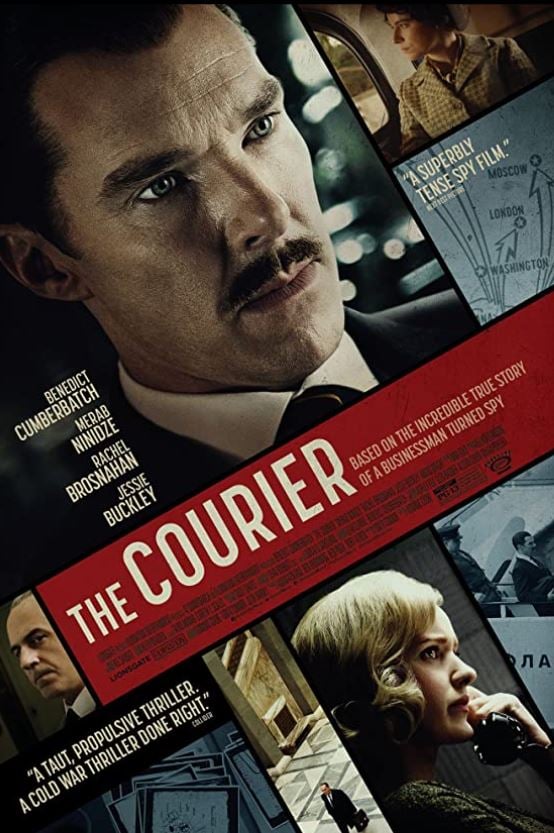
That Dominic Cooke's The Courier feels a tad stagey makes sense considering Cooke is a decorated British theatre director at the helm of only his second feature film. Benedict Cumberbatch plays the title character, an Englishman in 1960 who facilitates business partnerships. He is contacted by MI6 and the CIA to serve as an undercover liaison between a Soviet informant (the tremendous Georgian actor Merab Ninidze) and British and American intelligence, played by Angus Wright and Rachel Brosnahan, respectively. Cumberbatch is an actor of impressive versatility and presence; his five minutes near the end of the powerful WWI film 1917 crystallized the film's message of misery that comes from hubris. He delivers the same commanding performance in this crisp story of a man, who never pictured himself as courageous or sacrificial, answering the call, not of Mother England but of compassion and loyalty.

Chaos Walking


Director Doug Liman's futuristic Chaos Walking, based on a series of young adult sci-fi novels, is set light years from Earth in a world where the thoughts of men are manifested in light and images called Noise. Women are not so gifted (or cursed).
A "thoughtful" young man named Todd (the ever-winning Tom Holland) is being reared by two men (Demián Bichir and Kurt Sutter) who are farming land purposefully set apart from the rest of a settlement run by the scar-faced / fur-coated Mayor (the ever-intriguing Mads Mikkelsen), when a young woman named Viola (Daisy Riley of the Star Wars reboot) crashes from the sky into the womanless settlement and evinces for the Mayor and a mad preacher played by David Oyelowo that trouble is coming.
The film, which is more entertaining than not, introduces lots of notions and prompts tons of questions -- the reason for the colonization, the origins of the Noise, why it is attached to male DNA, what of the marauding humanoids called Spackle. These were quite likely fleshed out in the books but they kept the movie from developing into a fully coherent narrative for me.

Sunday, March 21, 2021

Another Round


Four Danish friends, teachers in the same high school who feel mired in banality, test a theory that staying in a state between inebriation and sobriety is the road to better personal and professional performance. This is the premise of Thomas Vinterberg's Another Round, nominated in Best International Feature Film and Best Director Oscar categories.

The wonderful quartet of middle-aged men is led by Martin (Mads Mikkelsen), the history tutor who has retreated into diffidence and distractedness to such a degree that his students challenge his laxness and his family ignores him. As the film begins, he speaks with quiet hesitation when he should be commanding attention. He's lost interest in his job, his students and his family and seldom sees his friends (played by Thomas Bo Larsen, Magnus Millang and Lars Ranthe).
All of that changes when they begin the experiment with inebriation and productivity, journaling their findings. Soon they each are turning corners and are breathing life into their students, awakening dormant minds and rediscovering passion. But, as these stories go, matters get out of hand and the drinking -- which increases in regularity, duration and potency -- leads to disaster.
Vinterberg has directed a marvelous film that is beautifully acted by the four principal players and several key featured players, especially Maria Bonnevie as Martin's dispirited wife, Anika.

Tuesday, March 9, 2021

The Mauritanian


Documentarian Kevin McDonald has directed a handful of feature films. Forest Whitaker won an Oscar and Golden Globe for portraying Ugandan dictator Idi Amin in McDonald's The Last King of Scotland (2006). Jodie Foster just won a Globe for playing attorney Nancy Hollander in The Mauritanian, McDonald's adaptation of Mohamedou Ould Slahi's memoir Guantanamo Diary, which recounts his torture while a detainee suspected of orchestrating the 9/11 attacks and Hollander's efforts with assistant Teri Duncan (Shaileen Woodley) to uncover the truth and secure Slahi's release.


While Foster is steely and efficient as a woman guided more by protection than affection, French actor Tahar Rahim pours so much heart and anguish into his portrayal of Slahi that the film seems almost pointless when he's not on-screen.

Some of that is also due to the wispiness of the legal aspects here. What is known now about extradition and torture was not known when Slahi was captured in 2002, and needed to be discovered, revealed by the players. The circumstances surrounding Slahi's capture and detention, the nature of the evidence gathered about him, the testimony of others supposedly involved in the attacks, the motives of his interrogators are touched on but mainly left to inference, which feels to me as if they are beside the point. I think doing so misses the point of Slahi's memoir.

It is becoming clearer and clearer to me that major motion pictures released in theaters are at a disadvantage to streaming services that can devote 5x the number of minutes to developing the complexities of these narratives. For all of its winning qualities -- Foster, Rahim and Benedict Cumberbatch as the Pentagon's lead prosecutor -- the film has the feel of a warm embrace of Slahi and those others wrongfully treated by the United States and not an exposition of how the country got it so wrong.

Wednesday, March 3, 2021

Nomadland

In Chloé Zhao's inspired and inspiring Nomadland, Frances McDormand plays Fern, a member of the tribe of "houseless" Americans who crisscross the country's expansive middle section chasing piece work and peace. Midway through the film, Fern sells the last of the possessions that will not fit in her life, that is, in her van. Fern, who followed, married, nursed and then buried a dreamy manchild in the middle of Nevada and never found her footing -- and perhaps herself -- again, meets fellow nomads in an RV park and chooses them, and they her, as family.

Zhao, using actual nomads in this film just as she cast damaged but determined bronc busters in The Rider in 2017, has an amazingly discerning eye for one not born in the U.S. (she's Chinese and schooled in England). She knows telling details and displays incredible patience with the film's pacing and its nuances. She balances breathtaking openness with remarkable passages of introspection, many of the most riveting are delivered by McDormand, who, once again, shows audiences why she is one of the most engaging and reflective actresses on the screen.
Nomadland's narrative sparsity and the impecuniousness of the characters stand in stark contrast to Middle American greed and waste. The storage unit industry generates $40 billion each year renting out the 2 billion square feet of storage space across the country.

The World to Come


The two women at the center of Mona Fastvold's beautiful and tragic story, The World to Come, are farm wives in Upstate New York in 1856. They are trapped in miserable marriages, beset by drudgery and isolation, but find in each other, first, kindred spirits then soul mates and then lovers.

Told through hauntingly poetic journal entries by Abigail (Katherine Waterston), the film unfolds languidly. Abigail's attraction to the amorous Tallie (a smoky and spectacular Vanessa Kirby) begins as an ember but eventually consumes her and pushes her to the brink of insanity.
Abigail, who is still mourning the loss of her young daughter to diphtheria, is unequally yoked to the honorable but forlorn Dyer (Casey Affleck), whose name is a homophone descriptive of the couple's precarious existence. Tallie is married to Finney (Christopher Albert), a scornful martinet, who resents the world, his wife and her resistance to bearing him children.
The exchanges between the women are seductive and warm, those with their husbands, coarse and cold. The women's exchanges with one another are entrancing. Their exchanges with their husbands, terse and epigrammatic, more proverbial than heartfelt.
Fastvold's direction is elegant, her attention to period detail extraordinary, and her love for these four unfortunate characters is in every frame of the picture.

Saturday, February 27, 2021

Malcolm and Marie


Sam Levinson's Malcolm and Marie is more trial than triumph. Though Zendaya and John David Washington deliver Levinson's abrasive lines capably, the animus between them feels inconsistent and so unpersuasive. Zendaya is the more persuasive as the addictive and self-loathing Marie, than is Washington as the genius filmmaker who has used his lover's pain as inspiration. They take turns butchering one another with revelations and confessions, tearing at each other because they both love and despise the other -- and themselves. Malcolm and Marie is exhausting and exasperating and left me wondering
"Why?"


Director Tim Story also has a recent releases. Story has directed the live action/animated rehash of the classic cartoon Tom & Jerry.

Story made his name with music videos. He has directed one commendable movie -- Barbershop (2002) -- but mostly blockbuster movie dreck that are panned by critics but generate dollars for the studios. For example, the blustering and bombastic Ice Cube / Kevin Hart vehicles Ride Along and Ride Along 2 drew in more than $200 million at the box office. Story's films aren't deep. Thematically, they're far from the emotional convulsions in Levinson's M&M. That Story's T&J, which I have no intention of seeing, will be judged as a banal money-grab is assured. And, frankly, that's fine with me.
Levinson's Malcolm and Marie is a race and sex minefield through which the two characters meander, setting off explosions for an hour and half for no apparent reason other than, perhaps, to feed the public's fascination with warring couples and to address the near absence of vitriol at this level being voiced by Black actors. Levinson is a relatively new filmmaker whose pictures are generally well-regarded but they don't make money. Why he chose to try to articulate the complexities in the relationship between a Black man and woman is not clear. But I'm cool with it.
I would love it if Levinson's Malcolm and Marie were truthful but he should be free to try and fail. And Story should be free to direct brainless fodder, the cinematic equivalent of the wings special at Applebee's.
That's what a post-racial America looks like.


Thursday, February 25, 2021

Mank


David Fincher's homage to delusional power, Mank, is a self-reflective tribute to Hollywood screenwriting. The crackling script was written by Fincher's father, Jack Fincher, who died nearly 20 years ago. The elder Fincher has no other screen credit. Mank is a fictionalized retelling of injured booze-hound and master wit Herman Mankiewicz's writing of Citizen Kane, which many critics consider the GOAT among motion pictures, despite it winning only best original screenplay in 1942. Mankiewicz, played by an always riveting Gary Oldman, constructs a thinly veiled parable about newspaper tycoon William Randolph Hearst's vain ambitions and outsized influence not only in Hollywood but in national affairs. The writing is initially hobbled by Mank's broken leg, from an auto accident, and his alcoholism, which would eventually kill him. But, with support from a young Orson Welles (Tom Burke) and a dutiful British secretary Mrs. Alexander (Lily Collins), Mank is able to produce his best work ever. Fincher, shooting in black and white, recreates the silvery shimmer of the '30s and '40s and dazzles with sumptuous production design and his trademark, often counter-intuitive camera work. Fincher's stunning visuals combined with his father's whip-smart erudition -- the words! the words! -- make Mank a thrill to watch and to listen to.

Friday, February 19, 2021

News of the World


British movie director Paul Greengrass is a master of the set piece, a fairly self-contained, highly charged narrative moment that lets virtuosic filmmakers strut their stuff. Greengrass may be best known to many for taking over the directing of the Jason Bourne franchise after the initial Bourne Identity. Both Bourne Supremacy and Bourne Ultimatum featured intricately choreographed scenes of pursuit in vehicles and on foot and close quarters hand-to-hand combat.

Greengrass's latest film, News of the World, is set in 1870 Texas and so does not have the thrilling complexity of the Bournes or the international intrigue of the 2013 Tom Hanks vehicle Captain Phillips -- but it does deliver the menace of a forbidding landscape as the backdrop for skirmish and slaughter by bitter, defeated hordes, chafing under the bridle of Yankee occupation.

In News, Hanks plays a former Confederate army officer, Captain Jeff Kidd, who travels the Texas badlands reading newspapers to townsfolks for a dime. In a sense, he's taken this as a calling, and Greengrass films the readings as if they were revivals. And that fits because before the war, Kidd was a minister and newspaper publisher (yes, an ironic combination when viewed through contemporary lenses). He answered the call and left his home and wife in San Antonio for the war but never returned. His agitation, palsy and itinerancy suggest lingering post war trauma.

The film's arc, which is neither sparkling nor cliche, has the Captain discovering the wreckage of a wagon and the body of a Black man hanging from a tree, a supremacist message tacked to his chest. The young white girl he was escorting to safety is hiding in the brush. She'd been rescued from a tribe that had killed her family six years before and raised her as a Kiowa. The Captain is charged with her safe delivery to her family, hundreds of miles away.

The young German actress Helena Zengel plays Cicada / Johanna, a fairly demanding role for a child, which has won her a Golden Globe supporting role nomination. The story evolves as one might expect, with Greengrass staging two especially intense sequences -- one in a canyon as the Captain tries to hold off three men who traffic in young girls and a night reading in a settlement run by a racist tyrant.

Hanks, who will be 65 this year, is a Hollywood senior statesman, and -- like Washington, Streep, Clooney -- has a magnitude that brings others into vehicles in which they can shine. Hanks is Hanks throughout News; he can be no one else. But the film also features solid moments from featured players. In addition to Miss Zengel, Michael Angelo Covino as the lead trafficker, Elizabeth Marvel as a Dallas hotelier and Captain's paramour and Fred Hechinger as a good-hearted young marauder are especially good.

Monday, February 15, 2021

Judas and the Black Messiah


Like the best of "true story" cinema, Shaka King's Judas and the Black Messiah operates in the past and present. As a dramatized re-telling of the FBI's infiltration of the Black Panther Party in Chicago using a car thief as an informant, the film, which is gripping in its construction and performances, documents J. Edgar Hoover's fixation on suppressing civil rights groups while making oblique references to modern-day protests against police violence.

Daniel Kaluuya and LaKeith Stanfield play, respectively, Chicago Black Panther commander Fred Hampton -- who was killed by city, state and federal agents in a raid on his home in 1969 -- and informant Bill O'Neal, who is depicted as giving crucial intelligence about Panther movement and strategy to field agent Roy Mitchell (Jesse Plemons), who recruited him. Kaluuya and Stanfield present Hampton's energizing oration and O'Neal's agitated duplicity with assurance. They're both captivating.


Kaluuya's performance, with his long speeches and face-offs with rival resistance groups, is the showier piece, and unquestionably deserving of praise, but Stanfield, to me, covers more emotional and psychological ground as a man trapped by his own petty criminality in a scheme that he cannot control. His scenes with Plemons are infused with anxiety and dread.


Hampton was a martyr to the cause of Black empowerment, but O'Neal is also a tragic figure. As presented in King's masterful film, the "betrayer" was collateral damage in a mission he could neither embrace nor would benefit from. O'Neal died in 1990, after running into traffic on a Chicago freeway in the middle of the night and being hit by a car. His death was ruled a suicide.

Monday, February 8, 2021

The White Tiger

Ramin Bahrani has set his ponderous "amorality" tale, The White Tiger, in modern-day India, the world's most populous democracy and a nation of rigid class divisions, crushing poverty and political corruption. His hero is Balram, the cagey driver for a wealthy family, whose obsequious demeanor masks the young man's bitterness. This bitterness sets the sardonic tone of the film's voice-over, but this is no comedic piece, like the similarly themed Parasite of 2019. Bahrani's story is cleverly written but, more than anything, it is unsettling.


Over the course of the film, Balram (a remarkably expressive Adarsh Gourav) is, by turns, treated like a beloved member of the household and like human refuse. The shifts are jarring and, quite likely, are reflective of the deep disdain the rich "big bellies" have for the poor "small bellies," i.e., decency, consistency and other-regard don't matter to those who control everything. (Sound familiar?) This treatment is maddening and there are moments in the film when Balram's sanity (or, at least his reliability as a narrator) seems to be in doubt. His encounter with the eponymous creature, a freak of nature whose birth presages great change, was one such moment.

The film's narrative is a variety of Bildungsroman, but in the case rathe than pushing through challenges to become a better person than circumstances would ordinarily permit, the hero grows up and corrupt, dehumanized by his country and by his relationship with two young members of the household -- Ashok (Rajkummar Rao) and Pinky (Priyanka Chopra). Ashok's seduction and Pinky's self-involvement light the fuse for the story's explosive conclusion.

Sunday, February 7, 2021

Sound of Metal


Darius Marder's Sound of Metal on Amazon Prime, along with pushing sound editing and sound mixing into new realms, asks some profound questions about human pain and resilience.

Riz Ahmed (in an excellent performance) is rock drummer Ruben Stone, who loses his hearing while touring and must adjust to permanent deafness. Stone is a recovering heroin addict in love with his performing partner, Lou, a woman with a history of self-abuse (Olivia Cooke). To say Ruben does not handle his new reality well would be to rob the character of his intensity and the film of its resonance.
Ruben eventually finds support in a program for the deaf run by a teacher / father confessor named Joe (Paul Raci), who challenges Ruben to do what appears to be the hardest thing for him to do -- sit with his deafness, be present for the world and others, learn to love himself.
Yeah, it's a little 12-Steppy but in the hands of a fine director and a winning cast it not only rings true but echoes long after the screen goes black.

Tuesday, February 2, 2021

The Little Things


I'm not surprised that John Lee Hancock's picture has provoked praise and scorn and ambivalence from critics. The thriller teams a gristly older detective with a spit-and-polish younger officer to track and capture a serial killer in Los Angeles.
It is fueled by fine performances from Denzel Washington, who is nearly 70, and Rami Malek, 40. They take Hancock's script, which is too often oddly elliptical when it should be more straightforward, and lend it vitality, needed focus and some emotional weight. Without their substantial talents, questions would pester and distract more than they do.
When Jared Leto as the jokey prime suspect is introduced, the tone of the film, which is fairly humorless, becomes, ironically, more menacing. This is welcome because prior to Leto's Albert Sparma's entry, the movie lacked essential tension. Then, the character and the story take a turn (literally) and set up the last act, which will either delight or enrage the viewer.
I found it strange that a film about a series of murders has no on-screen attack and only one crime scene procedural. The story is mostly trailing and fretting and a bit of unproductive navel gazing, which I think is a bigger deal. While I welcomed Joe Deacon's (Washington) weary cynicism at first, in the end it seemed to be more of a device to introduce the crisis for Malek's Jim Baxter than a legitimate exploration of a spiritual conflict among law enforcement agents.
Yes, the ending is jarring but when viewed through a lens of moral relativism -- and when considering the uneasy ground we find ourselves standing on these days -- it might not keep one up at night -- or at least as long.

Sunday, January 24, 2021

Ma Rainey's Black Bottom


In his American Century Cycle, playwright August Wilson (1945-2005) crafted 10 plays about the African American experience, each one set in a different decade of the 20th century. Ma Rainey's Black Bottom, set in the 20s, was the second work completed.

Award-winning Broadway director George C. Wolfe's Netflix film adaptation is based on a screenplay by Ruben Santiago-Hudson (a stage and television performer who has appeared in Wilson productions) that trims the original two-act script, one of the shortest in the Cycle, into a breathless, 90-minute period piece that retains the play's theatrical intimacy while intensifying the heat.

Much of the film's intensity is contributed by Viola Davis and Chadwick Boseman (one of his last major roles before his death earlier this year) as the eponymous Mother of the Blues, an irascible figure, and a reckless young trumpeter named Levee, who wants the fame that Ma seems to take for granted. Both are marvelous, but Boseman is brilliant as the manic music man, a battered and blustering braggart who is carrying literal and figurative scars of racial violence.

This wonderful production is quite different from 2016's Fences, which also starred Davis along with Denzel Washington, who directed. Ma Rainey, confined to a few hours of a recording session, does not have the epic sweep, the allegorical and spiritual overtones of Fences, which was awarded a Pulitzer Prize, along with another Cycle play that was adapted for the screen, The Piano Lesson.

Wilson's plays are dense and expansive, mixing history and folklore, mind science, philosophy and mysticism as they explore race and the nature of blackness in America. I would imagine they are bears to stage and challenging for audiences because Wilson's language is so rich, his stories so-reliant on the oral tradition. Some monologues go on for pages.

One interesting note concerning Santiago-Hudson's adaptation -- he changed Wilson's n***er to n***a in places when the boys in the band are referring to one another and retaining n***er when recounting threatening events involving menacing whites. Wilson's original script does not contain this distinction.

One Night in Miami


The catalytic role in Regina King's impressive directorial debut, One Night in Miami, is that of Malcolm X, played by British actor Kingsley Ben-Adir. It is Malcolm who convenes the meeting with soul man Sam Cooke (Leslie Odom Jr.), football legend Jim Brown (Aldis Hodge) and the newly crowned heavyweight champion Cassius Clay (Eli Goree) on the night of Clay's defeat of Sonny Liston for the title. It's 1964. Just months before both Cooke and Malcolm would die violent deaths.

That specter hangs over everything that is exchanged between the four old friends in that motel suite, giving Malcolm's urgency, his paranoia and perhaps monomania such chilling potency. He needs Clay's conversion to Islam to fuel his move to separate from Black Muslim leader Elijah Muhammad and the organization that Malcolm feels has grown corrupt and abusive. Malcolm will need followers to build his own movement, and he wants his friends to step up and energize Black Americans. The men are not altogether receptive to Malcolm's entreaties, but their love and respect for him keep them in the room.

The screenplay by Kemp Powers, based on his stage play, crackles with electricity, awareness and relevance. The lines are knowing and probative of the audience's understanding of the civil rights movement beyond familiar tales of bus boycotts and lunch counter demonstrations. One Night in Miami is not about strategy and tactics; it's about self-awareness, passion, conviction and the need to write one's own history. It's thought-provoking and splendidly acted, with a palpable sense of period and locale.

Monday, January 4, 2021

Our Friend film trailer

This film trailer bubbled up on my newsfeed this morning, coincidentally, the day after a friend and I had a pretty intense conversation about memorializing death.

We came down different paths to arrive at different understandings, he and I, but agreed that much of what folks do focuses on the experiences of survivors, which sometimes are only tangential to the life of the departed. Some monuments are less about loss than about the standing of the living, their prominence. And, we agreed, as long as church and commerce are involved it will ever be thus.

Reflection, reticence, regret.

The language we use -- pass, transition -- suggests not a termination but a continuation, a notion that has come down from antiquity, millennia before Jesus of Nazareth talked about preparing a place for believers.

This further suggests that for some of us the judgment of observers might be joined by the scrutiny of the departed. The acreage devoted to the disintegration of the mortal coil -- some count about 25,000 private and for-profit cemeteries in the U.S. -- is pretty astounding.

The crux for my friend is our apparent failure to imagine the dead within those graves, beneath monuments to what has passed, saying to those standing above, "Keep Living."

Elmer and the executive

  You can hardly blame Elmer and the executive for being cads. Audiences were just too willing to buy their guff. Folks feel good about the ...