Friday, March 25, 2022

Stew


L.A.-based, award-winning singer/songwriter Mark Stewart, who performs as "Stew," is, to me, the most enigmatic entertainer since Andy Warhol.

However, unlike Warhol, the gifted Stew doesn't seem to want to be famous, despite having amassed a respectable amount of celebrity in the alternative music sphere through his solo work, his incendiary chamber pop project "The Negro Problem," and on the stage.

Stew's solo recordings were named Album of the Year in 2000 and 2002 by Entertainment Weekly, and his semi-autobiographical 2008 rock musical Passing Strange, which he created with longtime collaborator Heidi Rodewald, won Drama Desk and Tony awards and was captured on film by Spike Lee.

Stew, a portly 61-year-old with a gray-flecked Van Dyke, writes thoroughgoing songs packed with catchy hooks and choruses and political and cultural allusion. His favorite topics are racial and sexual relations (the thread running through the episodic Passing Strange) and identity (both philosophical and political). His 2016 "concert novel" Notes of a Native Song, based on the life and writings of James Baldwin, was well-received and praised for its genre-busting innovation. When he tours, quite often with bassist Rodewald, Stew plays small venues where, one could well imagine, he is indeed the "smartest guy in the room."

I own most of the dozen or so recordings in Stew's catalogue, which he guards obsessively, refusing to publish his music or words. I love the post-modern "wokeness" of the man's vision, his audacity and the lyrical beauty in his best compositions -- many of which are hidden tracks on his albums.

Stew seems to practice the polar opposite of sound branding strategy -- daring the public to categorize his persona or attach themselves to him, much like the forlorn and elusive lovers that appear so frequently in his work.

On second thought, maybe the mystery IS his brand.


The Verdict


Sidney Lumet's riveting courtroom thriller The Verdict was released 40 years ago and retains its relevance.

Paul Newman starred as a drunken Boston lawyer who takes a wrongful injury case against a powerful hospital that is owned by the archdiocese. His first inclination is to sue for a quick payoff for himself and his client but his conscience kicks in and with the aid of another older attorney, played by Jack Warden, he raises the stakes and pushes for a negligence jury trial before a judge who dislikes him (Milo O'Shea). The church's attorney is a witheringly condescending Boston Brahmin played by James Mason. Lumet, Newman and Mason were all nominated for Oscars.
The sizzling Oscar-nominated screenplay was by David Mamet (Glengarry Glen Ross, American Buffalo) and based on a novel by Barry Reed. It is a familiar story of professional and spiritual redemption for Newman's Frank Galvin but it is also a morality tale that reminds us that "powerful" does not always (if ever) mean "right."
One of the high points in the film was the arrival of an anesthesiologist with a small women's clinic to challenge the hospital's narrative. It is clear when Dr. Thompson (played by Joe Seneca) deboards from the bus and is shown to be an older Black man that Galvin -- and presumably the audience -- is disappointed and fearful that Mason's viperous Ed Concannon will devour the gentle, old man on stand. It doesn't quite work out that way but the sequence is memorable in its depiction of pervasive race and class prejudice.

Black Moses (update)


Fifty years ago, Isaac Hayes won the Academy Award for Best Original Song for "Theme From Shaft." The picture and the soundtrack were released in '71, and they were all "bad mother..."
The same year, Hayes released Black Moses, and I would eventually spend many hours of my uncertain adolescence with Ike's smooth, orchestrated soul.
Black Moses included Ike's rendition of "(They Long to Be) Close to You," a 1970 Burt Bacharach and Hal David song that was covered, according to one count, five times the year before Black Moses was released. It was taken to the top of the charts by The Carpenters in '70 even though Perry Como, Diana Ross and Johnny Mathis were among those who covered the song the same year.
Who doesn't know this refrain? "On the day that you were born The angels got together And decided to create a dream come true So they sprinkled moon dust in your hair of gold And starlight in your eyes of blue."
Bacharach ~ a pop composer of the highest order ~ covered the song himself in 1971, with his distinctive though limited vocalizing. I was already familiar with his version of "Close to You" when the needle slipped into Ike's groove.
Being the Black Moses, Hayes wasn't having any of the blond-and-blue business; He omitted the references to "hair of gold" and "eyes of blue." I suppose he understood how marginalizing singing the original lyrics would be to many in his audience. (Mathis and Ross performed versions that included the original words.)
Hayes intoned, "On the day that you were born, the angels got together and they decided to create a dream come true so they sprinkled moon dust in your hair and I see heaven when I look at you."
Ike's rejection of the ABS (American Beauty Standard) in song resonated over the years, and not just for me. More than 30 years after Black Moses, soul singer Gerald Levert performed a version of the song that featured these lyrics.
"On the day that you were born The angels got together And decided to create a dream come true Yes, they did So they sprinkled moon dust in your hair And sunlight in your eyes, like they do." Not Keats, or Hayes, but it gets the job done.
Ike would eventually hang up his Black Moses drag for, until a few years before his sudden death in 2008, a chef's togs and cap on the animated series South Park. As unconventional as he may have become with his Scientology pronouncements, he will always get props from me for pushing his way out of the margins and bringing me and countless others along with him. Had he lived, Hayes would be 80 in August.

The Lost City


When Aaron and Adam Nee's The Lost City is funny, which it often is, it is VERY funny. It also has some pretty leaden bits -- but none of them involve stars Sandra Bullock and Channing Tatum, who keep this trifle of a rom-com afloat with their sure chemistry and splendiferous comic timing.
Bullock plays a blocked and secluded writer of adventure romances who is grieving the loss of her archaeologist-husband, the man who kept her stories grounded and authentic. Tatum plays the studly cover model for her books, who has become a fan favorite on book tours, much to the author's chagrin.
Over the course of a few days, Bullock's Loretta gets kidnapped by a treasure hunter (a spritely Daniel Radcliffe) who believes her most recent book contains keys to a lost kingdom of riches in the Atlantic. Tatum's cover model Alan attempts a rescue aided by an even studlier extractor played by Brad Pitt. And the whole crew is pursued by Loretta's publisher (the larger-than-life Da'Vine Joy Randolph).
Yes, much of the story is Raiders retread but the movie works because of pure cheek and silliness, even though the last reel does offer some riffs on those things that are really important in life.
Fifty-eight-year-old Bullock, who is one of the film's producers, will surely get rousing rounds of "you go girls" as her character shakes off self-pity, scales a mountain, outsmarts the bad guys and merengues with her 40-year-old Magic Mike in an island village.

Thursday, March 24, 2022

X


Delaware's other favorite son is writer / director Ti West, whose latest horror flick after a lengthy hiatus in televisionland is titled "X" -- as in X-rated and X-cessive and X-ceptional.
British actress Mia Goth (Emma.) is an eager, young woman in 1979 Texas who wants to make it big in the burgeoning home video pornography industry. She and her boyfriend / producer Wayne (Martin Henderson) and his crew (Brittany Snow, Kid Cudi, Jenna Ortega, Owen Campbell) rent an isolated guest house owned by a decrepit farmer (Stephen Ure) and his wife (Goth also plays the part of the randy old woman). All goes well with the filming until old Pearl starts getting ideas and then things "go to hell" pretty rapidly.
The film is divided neatly into two acts -- the build-up with the filming of the movie and then the aftermath, the hunt. West stages a nice, split-screen musical interlude with the characters played by Snow and Cudi performing "Landslide" while old Pearl pulls a brush through her thinning, white hair and smears shadow on her lids. It's a quiet, artful breather before the chaos.
In "X", West invites audience members to think about their own relationships to sex and violence, as he blends these elements in fascinating ways, prompting viewers to consider which is more repulsive.

Tuesday, March 8, 2022

Paul Dano


I only know the actor Paul Dano by his work on the screen. I've never listened to or read an interview with him. Still, he strikes me as grounded and disciplined, his own creation, the result of years of reflection and self-assessment.
Dano seems to know his instrument -- body (lanky, non-descript), face (pudgy, oval), voice (shrill, grating) -- and what best suits it. Ironically, he strikes me as supremely sane even though he gravitates toward characters that are not.
I first noticed him in Little Miss Sunshine (2006), a film in which he played an electively mute boy. He was great. The other day I was thrilled (and chilled) by his portayal of The Riddler in The Batman. And among his work in between, There Will Be Blood (2007), 12 Years a Slave (2013), Love and Mercy (2014), Swiss Army Man (2016). I have since learned he appeared in 2001's L.I.E., a disturbing, challenging movie I've seen but don't remember his being in.
If even part of what I surmise about the young actor is true, he's a model of brand cultivation. A highly identifiable and bankable asset for any film he's attached to, any project he chooses, which quite likely will ensure him a long career, like many other splendid character actors who don't often get leading roles.
Maybe a healthy, grounded self-concept is all you need for success.

Sing 2


Writer/director Garth Jennings reserves the choicest character in his animated Sing franchise for himself -- the ridiculously capable reptilian director's assistance Miss Crawly. Her wall-eyed antics nearly steal what is actually a pretty terrific show.
Matthew McConaughey as the gritty little koala impresario Buster Moon and crew of A-listers from 2016's Sing (Taron Egerton, Reese Witherspoon, Scarlett Johansson) return in Sing 2 to voice the tuneful menagerie of showbiz hopefuls looking for their big break. The storyline is as old as the hills -- Mickey and Judy putting on a show in the barn -- but given new life through the animal angle, its evocation of those ubiquitous TV talent competitions and the assortment of old and nu-skool numbers that are imaginatively staged (the animation by Illumination is marvelous), even if the plotting is a little predictable.
This franchise and Illumination's other mega-hits Despicable Me and Minions seem to have nailed the elusive balance of wit and wonder that is essential for animated family features. While adults might not be as dazzled by Sing 2's eye-popping artfulness, many will surely be flicking lighters (metaphorically) at Bono's cameo as the grief-stricken, isolated rock 'n' roller who rediscovers his voice.

The Batman (2022)


Matt Reeves' The Batman (2022) works so well because it cares enormously about story and not just action.
The film's nearly 3-hour length is evidence of Reeves' commitment to restoring the original comic series' "Detective" focus and noir atmospherics. It delivers riveting procedural explication, gangster-land shoot ups, and several spectacular set pieces, including a brilliant auto chase between Batman and the Penguin.
The villains (Paul Dano's Riddler, John Turturro's crime boss and fixer, and an unrecognizable Colin Farrell, the aforementioned Penguin, mainly) are not the cartoonish fiends from the TV series or earlier stabs at this material, but mad connivers, schemers and scoundrels, roving bands of punks, mobsters, bad cops and worse politicians, all preying on Gotham City (New York City's proxy) and its residents.
Robert Pattinson's Bruce Wayne / The Batman may be the darkest and most dyspeptic put on film, but his performance works because the city he's trying to save, if not renew, is in perpetual darkness, so filthy the rain that's constantly falling will never clean it. His dour interior matches the depressive exterior world but he seems committed to push through both.
His partners in the crusade are one of the few good cops in the city, Lt. Gordon, played by Jeffrey Wright, who never disappoints, and a mysterious, high-kicking Catwoman (Zoë Kravitz), who is conducting her own campaign against corruption. While supporting players, they add levels of humanity and humanness to what is ostensibly a crime-fighting flick.
The film's climax, set on the day after the mayoral election in Gotham City, features a group of masked vigilante's radicalized over the internet by Dano's Riddler. It's a masterful conclusion that is also unsettling, in light of the events of Jan. 6, 2021.

Saturday, February 26, 2022

Cyrano


British director Joe Wright might well be the last Hollywood romantic in both his selection of stories and how he chooses to tell them. Atonement (2007) and Anna Karenina (2012) were sweeping, dramatic renderings of a contemporary and classic tale, respectively, that shimmered with their characters' longings and desires, intemperance and regret.

Wright gives similar treatment to the story of the lovelorn Cyrano de Bergerac, the 17th century French poet and swordsman who pines for the beautiful and, presumably, unattainable Roxanne and channels his ardor through one of her handsome suitors. It is easy to see why this tragic story has so often been adapted for the screen -- Cyrano is every person who was more in love with pride than with truth and paid the price for it.

Wright's rendering -- while a bit uneven in the casting -- is lush with lyrical beauty, both narratively and musically. For once, a trailer did not include the film's richest moments. The movie's dozen songs were composed by Aaron Dessner and Bryce Dessner with lyricists Matt Berninger and Carin Besser. "Someone to Say" is the film's main romantic theme featured in trailers but three other numbers struck me as wonderfully evocative -- Cyrano's solo "Madly," the trio "Every Letter" and the soldiers' requiem "Where I Fall."

I loved that the picture feels both Baroque and modern, in design and in movement. Some may fault it for merging these tones but I did not mind it as much. Cyrano's opening lines delivered to a crowd of powdered wigs and décolletages have the swagger of a rap battle. I thought it was a wonderful sequence.

Others have noted that Peter Dinklage carries this film on his back as Cyrano, his "ugliness" in this version being his stature. Dinklage, who is also a fine baritone crooner, is without question the reason this film has emotional resonance, even though Haley Bennett as Roxanne, Kelvin Harrison Jr. as her tongue-tied inamorato Christian and Ben Mendelsohn as the lecherous Duke De Guiche all give quality performances.

Dinklage's portrayal -- most of which is conveyed in his eyes -- feels more full-bodied and, somehow, more invested, and one doesn't have to guess where the connection comes from.

Uncharted


Ruben Fleischer puts Tom Holland's million-dollar affability to work in the actioner Uncharted, a fairly diverting film based on a popular hidden-treasure game.

Holland -- whose net worth, at age 25, is estimated to be just south of $20 million -- is treasure hunter Nathan Drake, a bartender and "smooth criminal" who inherited his brother's fascination with a fortune hidden by Ferdinand Magellan's crew at some point during their voyage in the 16th century.

Drake is recruited by an older and fundamentally untrustworthy treasure-seeker named Sully (Mark Wahlberg), who claims to be a friend of Drake's brother, Sam, (played as a youth by Rudy Pankow). Sully convinces Drake that he has uncovered important clues to the Magellan gold and needs the younger man to help him find and recover it.

Standing between the two fortune hunters are bad agents, killers and false friends (Antonio Banderas, Tati Gabrielle and Sophia Ali, respectively), and the whole crew globe-trots through increasingly outrageous set pieces following cryptic clues left by the pirates. These breathless scenes -- which are actually the sole reason to see the picture -- are well-staged but in the end feel a bit done.

Death on the Nile


Kenneth Branagh's Death on the Nile (2022) is a stylized beauty of a picture that boasts staging and performance affectations that will appeal to fans of Old Hollywood murder mysteries while boring those expecting grittier fare.


As with 2017's Murder on the Orient Express, Branagh teams up with screenwriter Michael Green in recasting an Agatha Christie / Hercule Poirot whodunit as a story of good and bad love between and among "people with property" and "people as property."


After an interesting black and white prologue set during World War I that reveals the origin of Poirot's famous moustache, the story moves forward 20 years to the nuptials of a beautiful English heiress (Gal Gadot) and her handsome but poor beau (Armie Hammer) and their honeymoon cruise in Egypt, where the heiress is killed and all of the invited guests are suspects.


Branagh, a celebrated stage actor and director, has an eye for spacial composition and like his Poirot a fastidiousness for order and symmetry. The movie's interiors are immaculate and pristine; its exteriors expansive and captivating. I thought it was a delightful picture to rest my eyes on and savor the craftsmanship on display.

Dog


Co-directors Reid Carolin and Channing Tatum take famliar and bankable formulas -- the buddy picture and the road movie -- and tweak them to fit Tatum's ebullient, mouthy strut and remind viewers of the walking wounded among us.


In Dog, Tatum is cast opposite a Belgian Malinois, and they both play Army Rangers traumatized by duties in the Middle East. They are on a five-day trip to attend the funeral of another Ranger, the dog's handler and Tatum's squadmate who had just killed himself by driving into a tree.


Tatum's sidelined and battle-scarred Briggs is offered the deal of transporting the seemingly unconrollable Lulu from Oregon to Arizona in exchange for another paid assignment, despite doctor's warnings that his head injuries, for which Briggs is being treated, are debilitating. After Lulu attends the funeral, Briggs is to turn her over to the Army to be destroyed.


As one might expect, the story is told episodically and reveals pieces of what Briggs and Lulu have lost in service to their country. The film, which is pretty entertaining, plays to Tatum's strapping boyishness but never lets us forget that his character is not a well man. The picture doesn't always maintain its equilibrium but it never falls into pandering or ridicule.

The Falcon and the Winter Soldier


Marvel Studios routinely blends heroism and vulnerability in its characters but its treatment of the ambivalence Sam Wilson / Falcon (Anthony Mackie) initially feels about assuming the role of Captain America, a post nearly everyone but Wilson sees he is supremely suited for, is exceptionally well-done, even if the last episode gets a little preachy.

In The Falcon and the Winter Soldier, the usual fight-and-flight superhero plotting is enhanced by references to America's racial history, personoified by Carl Lumbly's Isaiah Bradley, a Black man used for super-soldier experimentation and then abandoned. (Echoes of the Tuskegee Experiments are surely not accidental.)

Bradley's resentment and Wilson's anxiousness mixed with the elevation of a "fair-haired boy," a traumatized Afghan veteran played by Wyatt Russell, to be the new Captain America converge into a compelling statement about truth and legitimacy.

Underpinning all of this are the increasingly dangerous actions of a racially diverse, globe-trotting band of amped-up, disaffected youths pushing for world change. Who is best suited to respond to the threat?

The series' white characters are neither rabid racists nor woke warriors. Everyone seems to be a work-in-progress -- another characteristic to be found in the best of the Marvel Universe features. This is especially true of Bucky Barnes / Winter Soldier.

An important, albeit brief, exchange comes in the final episode when Barnes apologizes to Wilson for pressing him to step up, not understanding what it would mean for a Black man to take up Captain America's shield (literally and figuratively). This felt like a genuinely healthy exchange between friends/co-workers/partners. Sometimes all it takes is owning one's ignorance.

Marvel fans will know Barnes' character has a special affinity with Black characters, having been treated and protected in Black Panther's Wakanda, where he was known as White Wolf. Because of his long residence in that African nation, he was, as the saying goes, "invited to the barbecue," where he was shown along with Wilson's family and friends at the episode's end.

Licorice Pizza


True to form, Paul Thomas Anderson's latest film Licorice Pizza blends exactness with surrealism in its depiction of a visionary schemer (and / or scammer) in his habitat.

Anderson's period and subject is early '70s Southern California where a 15-year-old entrepreneur and actor named Gary Valentine (Cooper Hoffman, son of the late Philip Seymour Hoffman), of Sherman Oaks, convinces an aimless and angry young woman named Alana Kane (Alana Haim) to join him in a few misshapened money-making opportunities (selling waterbeds, opening a pinball arcade), with the unspoken assumption that one day she would disrobe.

Young Gary joins the ranks of Anderson's other great minds -- the porn producer of Boogie Nights (1997), the petroleum prospector of There Will Be Blood (2007), the conniving conman of The Master (2012), the fashion fetishist of Phantom Thread (2017) -- but Gary's obsessions don't lead to ruin or madness. He realizes chasing a dream often leaves one wondering what is to be done with the dream once caught. Maybe life's true joy is in the chase. An important consideration.

Alana's journey is as important as Gary's as she commandeers his plans to keep them on the rails. She discovers a lot about her own capacities, separate from the alienating expectations of her family or her semi-employed friends or the false idols she's erected to give the world meaning. Alana's brashness gives the picture its spark, her brittleness its heart.

Licorce Pizza takes its name from a chain of California record stores and the film itself features an abundance of Nixon-era AM radio hits.

Tuesday, February 8, 2022

Best Picture 2022


FWIW, this year's Best Picture Oscar nominations feel mostly right to me.


BELFAST -- Warm and affectionate movie directed by and featuring British film royalty, both nominated along with the director, Kenneth Branaugh. Strong story. Leads weren't nominated. Won't win.

CODA -- Jagged, unapologetic and emotive film that features deaf actors (one nominated) as central players. Touching and affirming. Won't win.

DON'T LOOK UP -- Smart-ass message movie lousy with Hollywood A-listers and a killer ending but an unrelentingly condescending tone. Won't win.

DRIVE MY CAR -- Little-seen, foreign-language film based on a story by a contemporary literary master, Haruki Murakami. Dunno. Haven't seen it.

DUNE -- Technically spectacular re-crafting of an impossible story. No acting nominations. And the director wasn't nominated. Won't win the big prize.

KING RICHARD -- Will Smith-produced story of the exceptional, though flawed, man who groomed two tennis champions. Smith might win, he's overdue. His co-star Anjanue Ellis is also nominated for several strong scenes and holding her own with Smith's imposing on-screen presence. Picture won't win.

LICORICE PIZZA -- So much works about this picture even when the audience feels they've wandered into madness. But that's Paul Thomas Anderson -- as distinctive a cinematic vision as any. Neither of the leads is nominated. The script crackles but the movie won't win.

NIGHTMARE ALLEY -- Beautiful homage to film noir. Visually splendid but director Guillermo del Toro was not nominated, oddly, nor was any of the cast. Won't win.

THE POWER OF THE DOG -- Everything works in this picture. Story, performances and scoping. Four acting nominations, including Jesse Plemons, who was overlooked for the Globes. And Jane Campion is nominated for directing. Almost a sure thing.

WEST SIDE STORY -- It's got Spielberg, a star-making supporting performance from Ariana DuBose, and is wonderful in the moment but, weirdly, has little staying power. Won't win.

Monday, January 31, 2022

Parallel Mothers


Pedro Almodóvar's Parallel Mothers unfolds like a flower, revealing the uncertainty and complexity of its characters' lives. The mothers of the title -- Janis (Almodóvar's longtime collaborator Penélope Cruz) and Ana (new face Milena Smit) -- meet in a Madrid hospital where they are both about to deliver their first child. Janis, the almost-40-year-old fashion photographer, is jubilant with anticipation; Ana, a disaffected and alienated teenager, is not. They bond and enter single motherhood the better for having met ... at first.
As is his practice, Almodóvar folds into this already rich story of human (dis)connections socio-political elements that extend the film's message beyond the intimate to the universal. This time, the subplot involves Janis's grandfather, who was executed by Francoists and tossed in a mass grave with other anti-fascists. Janis enlists the help of a handsome archaeologist (Israel Elejalde) to exume the remains so that family members might bury them properly. This leads to personal entanglements.
Cruz's Janis is the emotional center of Almodóvar's film of two mothers, but Smit's Ana, a needy and dyspeptic character, no longer a child and not quite woman, is an intriguingly hazy mass of conflicted emotions and raw need. Her distress meshes well with Janis's own.
As provocative as Almodóvar enjoys being on behalf of people and causes close to him -- particularly LGBTQ+ rights -- the story of these two women feels uniquely of the moment, as societies clash in so many corners about women's liberty and threats to their freedom to choose their own happiness.

Wednesday, January 26, 2022

A Man Named Scott


Robert Alexander's documentary on hip-hop entertainer and actor Kid Cudi, A Man Named Scott (2021), is a highly affecting film. It is intriguing because Cudi, birth name Scott Ramon Seguro Mescudi, is so engaging as he and his collaborators describe his creative process, the substantial impact his musical vision has had on millennial culture, and the nearly crippling depression he's battled much of his adult life.

Cudi's emergence as a creative innovator tracks along with changes in the recording industry, which maddingly embraces both the "sure thing" and the "change agent" and wages fierce battles to contract and control bankable artists. Cudi attributes the success of his experimentalism to tapping into emotional veins that other rappers were either ignorant of or chose not to acknowledge. This left Cudi as a singular voice speaking to uncertainty and despair, feelings his listeners connected with.

Counted among his fans are celebrity friends who appear in the film, Shia LaBeouf, Jaden and Willow Smith, Timothée Chalamet, and, of course, Ye (formely Kanye West). His fans followed him devotedy through his musical explorations, they say, because his words never failed to be salient and important.

Alexander's film, his first documentary as a director, is artfully constructed, going beyond the usual interviews and file footage of concerts or recording sessions to incorporate theatrical performances that illuminate Cudi's narrative. It's a beautful and important work.

The Tender Bar


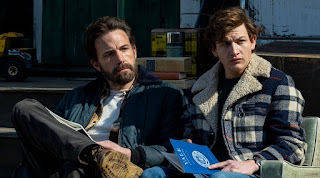
George Clooney's The Tender Bar takes a familiar coming-of-age story (based on the memoir by J.R. Moehringer) and turns it into a rumination on the people and events that give our lives structure by their presence and their absence.

Tye Sheridan plays J.R., a young man who has grown up on Long Island under the watchful eye of his mother (Lily Rabe) and with the loving tutelage of her brother, his Uncle Charlie, played with wonderful ease and enormous charm by Ben Affleck (in top acting form). They are all living with J.R.'s grandparents (Christopher Lloyd and Sondra James) in a clapboard house that's barely large enough to hold them and the various aunts and cousins who use it as a port during life's frequent storms. They're a loving, unkempt, directionless mess.

Uncle Charlie owns a bar, The Dickens, and is as schooled in the ways of the world (and man science) as anyone, due primarily to his voracious appetite for great books. He pushes young J.R. (played as a boy by the impressive child actor Daniel Ranieri) to read, which inspires the chronically indecisive boy to set his sights on being a writer.

J.R. gets a scholarship to Yale, falls badly in love, establishes a lifelong friendship but carries around the weight of his absent father (Max Martini), a radio D.J. who abandoned the family shortly after J.R.'s birth and only appears or calls to assure and disappoint. This is something J.R. must be rid of before he can move on.

Clooney is adept at bringing his players into close proximity, in spaces where they exchange intimacies, soft lies and hard truths. Every barstool wise-crack, callow insensitivity or naive reveal feels real. And that's the picture's true strength, despite some unevenness in character development and narrative flow, it feels really authentic.

Monday, January 17, 2022

Scream (2022)


Scream (2022) pulls off a pretty neat parlor trick. It tells the audience exactly what it's doing, what the franchise and other similar slasher movies have done, reunited surviving members of the legacy cast, winked at the audience of fankids who are WAAAAAAAYYY too smart for their own good, revealed the ending long before it arrived and STILL was able to deliver genuine jolts and surprises. Well done!

Belle (2021)


Japanese director / animator Mamoru Hosoda's lavish Belle (2021) is the umpteeth retelling / recasting of the Beauty and the Beast fairytale, set both in an enormous virtual world called "U", over which a beautful singing avatar named Belle rules, and in actual southern Japan, where a withdrawn high school student named Suzu seems to be losing the struggle with adapting to her mother's death years before. How these two worlds rise and converge is the gist of the story, whose pacing is more deliberate than game-based anime but which succeeds with a thoughtful storyline and characters that have more dimensions than one might expect in an animated feature. I regret the dubbed version of the film and not the original Japanese with subtitles was screened at my showing. I prefer seeing and hearing the product as the director had intended.

Monday, January 10, 2022

The 355


Simon Kinberg doesn't deliver much that's new for the super-spy genre in The 355. Even its central premise of a team of international female "bad asses" teaming up to avert global catastrophe by retrieving a device that could subvert and control the cybersphere doesn't feel especially fresh. The same "ladies get it done" swagger we've been seeing for decades.
The picture -- which stars Jessica Chastain, Diane Kruger and Lupita Nyong'o as American, German and British assets, respectively, along with Penelope Cruz as a Colombian psychotherapist to spies and Bingbing Fan as a Chinese double (triple) agent -- delivers some good thrills but two or three set pieces that go too long for the punch they pack. A bit more story (more about what drives these women), less close-quarter fighting (it all becomes a blur) and one or two fewer double-crosses (secret agencies cannot be that porous) would have greatly improved the picture.

Sunday, January 2, 2022

The Tragedy of Macbeth


Joel and Ethan Coen are motion picture royalty, having written/directed/produced innovative and enigmatic features for the past 40 years, often with Joel's wife, Frances McDormand. Joel Coen has recrafted Shakespeare's The Scottish Play and cast Denzel Washington in the lead role, with Frances McDormand as the Lady of the house.

Coen has edited the text, even though the original play is among the shortest by the Bard, and fully diversified the casting, all of whom deliver solid, classical readings. Coen has also enhanced the play's spectral elements, recrafting the tale as a phantasm in stark black and white on sets and locations that evoke both the staginess of Olivier's Hamlet (1948) and the surrealism of Bergman's Seventh Seal (1957). The result is an exquisite and invigorating reimagining of this familiar story of bloody ambition and madness. As one might expect, Washington and McDormand are terrific, but I also found the performances by Alex Hassell as Ross, the nobleman and messenger, and Kathryn Hunter as the witches, striking and highly memorable.

Elmer and the executive

  You can hardly blame Elmer and the executive for being cads. Audiences were just too willing to buy their guff. Folks feel good about the ...