Saturday, June 29, 2024

A Quiet Place: Day One


Michael Sarnoski's A Quiet Place: Day One is more love story than alien-invasion origins picture.

It's not a conventional love story, by any means, but is romantic nonetheless, that is, between the attacks by the towering invaders who are blind but hunt prey through sound. Survivors quickly learn if they want to survive, they will remain silent.

Day One is also not a conventional origins picture. While it depicts the first wave of ravenous extraterrestrials landing in New York and decimating the population of that noisy city, the picture -- written by Sarnoski; John Krasinski who directed the first two installments and wrote the screenplays with Bryan Woods, who returns for Day One -- doesn't really tell us why this happened. Who did the Earth piss off? In that regard, it certainly isn't the only horror / sci-fi flick that doesn't describe the invaders' motives. Maybe it doesn't matter.

Lupita Nyong'o stars as Sam, a poet and last-stage cancer patient on an outing with other hospice patients when the leggy predators descend. She and her "service cat" survive multiple assaults and midway through the picture team up with British law school student Eric (Joseph Quinn).

Nothing lowers walls and defenses like a clear and present danger. Per force, Sam, imbittered by her disease, and Eric, who fights debilitating panic attacks, become a team, even though Sam is determined to walk uptown for a slice of pizza before the inevitable end. Evacuation boats are loading in the opposite direction.

It is this narrative twist that signals to Quiet Place fans, among whom I count myself, that this chapter is unlike the previous two, which starred Emily Blunt and John Krasinski and were about survival tactics and family bonds.

Day One is also about survival but I think more importantly it is about love of humanity and place. Sarnoski's final reel -- a rescue on the docks -- nailed this for me with a wonderful mix of terror and tenderness.

Thursday, June 27, 2024

Inside Out 2


Disney / Pixar's Inside Out was all eye-popping braininess in 2015, as it took audiences on a fantastic ride through a young girl's excitement and angst and she makes adjustments after her family moves from the Midwest to San Francisco.

The ingenious concept behind the Oscar-winning first film was the anthropomorphizing of young Riley's emotions -- Disgust, Anger, Fear, Sadness with Joy (voiced by Amy Poehler) at the helm of the control panel in Riley headquarters. Joy keeps the others in line, tempering their destruction and offering insight into how emotions contribute to building Riley's sense of self.

In 2, Riley, voiced by Kensington Tallman, finds herself confronting puberty, preparing for high school and hoping to join its kickass hockey team. New teenager emotions arrive -- Envy, Ennui, Embarrassment and their boss Anxiety (voiced by Maya Hawke / daughter of Uma Thurman and Ethan Hawke).

Anxiety sidelines Riley's Joy and other trusted emotions and commandeers the girl's thinking and responses during a hockey skills camp, during which she confronts darker sides of her personality.

Inside Out 2 is pretty heady stuff (pun intended), and I believe might be beyond the understanding of those younger than tweens. But, like its predecessor, it's a beautifully written extended metaphor that is brilliantly animated and contains an intriguing hint about Riley and a dark secret filmmakers aren't ready to reveal just yet.

We'll have to wait for 3.

Wednesday, June 26, 2024

The Bikeriders


Writer / director Jeff Nichols' elegy to American motorcycle clubs is about short-tempered manchildren in '60s Chicago, who appear to love their machines -- and one another -- more than their wives and children.

This could easily have been a short-subject film, but Nichols trusts most of his engrossing story (based on a book by Danny Lyons) to the care of one biker wife, Kathy, played by the inestimable Jodie Comer (Killing Eve, The Duel).

Kathy recounts for photojournalist Danny (Mike Faist of The Challengers and West Side Story), who started riding with and documenting the club while a university student, how she met pretty boy / hot head Benny (Austin Butler) and the enigmatic club founder Johnny (Tom Hardy), who was inspired after watching Brando's The Wild One.

Kathy recounts the growth of the club from a ragtag group of brawny misfits and malcontents to a nationwide organization of pretty much the same -- owing much of the expansion to the disaffection of young men of the day and the disillusionment of soldiers returning from Southeast Asia.

Kathy tells of Benny's dogged pursuit of her, his disregard for societal norms and his own personal safety, and the tension within the ranks, between the old crew and the newbies. She tells of Johnny's inability to manage the clashes and Benny's resistance to taking over as head.

Though Kathy is on the periphery of the biker turmoil, she clearly sees how it is affecting the men she's gotten to know perhaps better than they know themselves. She makes the stakes palpable ... and the outcomes for Benny and Johnny seemingly inevitable.

The Bikeriders boasts a large cast of featured players, most prominently Michael Shannon as a grizzly anti-pinko named Zipco, Damon Herriman as Johnny's solid right-hand Brucie, and the young actor Toby Wallace as The Kid, whose anger and ambition affects the future of the club.

Still, this is Comer's picture, thoroughly and unmistakably. She gives an award-winning performance as a woman in love with a man who doesn't seem to know what that really means, and she presses on anyway.

Sunday, June 23, 2024

John Wick Redux


I've been re-watching the John Wick series the past few weeks and reflecting on the humanity that underpins the story of a "retired" assassin re-activated by the theft of his beloved supercharged 'Stang and the killing of a puppy left to him by his recently deceased wife.

Wick, known as The Boogeyman by members of his extensive tribe of hitmen and their handlers, uncorks his formerly sublimated demon as his retaliation against those who wronged him cascades into one vengeful battle after another on nearly every continent and against countless foes within a system with strict rules and rituals that seem almost medieval.

The narrative world in which all of this happens is as fanciful as any mythical realm that operates on its own system of logic. Though Wick is supposedly a ghostly figure, everyone in New York and abroad seems to know him. In fact, everyone in New York seems to be working for the same global criminal operation known as the High Table, its members represent the collective interests of organized crime around the world.

Wick -- played by Keanu Reeves, as everyone knows -- is a Russian orphan raised by the mob "to serve and be of service." He was a star pupil and an unstoppable killer -- until he fell in love and wanted out. As a condition for his freedom, he was given an impossible task but completed it and left. He was done for five years, then his wife got cancer and died and a week later the sociopathic son of a former associate steals his car and kills the dog and that's where the series begins.

That Wick is running for his life across the four films and is forced to dispatch dozens of opponents in amazingly creative ways makes him a noble figure, fighting against nearly impossible odds to save his soul. His cause balances the outrageous body count.

John Wick is every person who is faced with impossible choices while confronting circumstances not of their making. Repeatedly Wick is told that he is fighting against his nature but the film shows he is a creation of a system he did not choose. A system he rejected once he discovered a greater truth.

Tuesday, June 11, 2024

Bad Boys: Ride or Die


The long-in-the-tooth Will Smith / Martin Lawrence buddy cops, 4-deep franchise, Bad Boys, offers fans highly digestible actioners with a tried-and-true formula -- sharp-shooter straight man (Smith), his mouthy sidekick (Lawrence) and irredeemably evil villains.

This formula has been a bonanza for both lead performers and quite likely anyone else attached to the series. Estimates are Smith earned about 40 million for the first three pictures; Lawrence a little over 30 million.

Michael Bay directed the first two films, and the latest entry -- titled Ride or Die -- was directed by the Belgian team Adil El Arbi and Bilall Fallah. It continues with the narrative of 2020's Bad Boys For Life, also directed by Arbi and Fallah. In that picture, Smith's Lowrey and Lawrence's Burnett, special forces cops in Miami, lost their trusted and beloved C.O., Captain Howard (Joe Pantoliano), in a botched operation.

In the latest film, Howard is posthumously accused of conspiring with the drug cartel his team had been investigating and in which Lowrey's son by a cartel operative, Armando (Jacob Scipio), was a key player and assassin. The Bad Boys mount up with their trusted team -- Kelly (Vanessa Hudgens) and Dorn (Alexander Ludwig) -- to find the evidence needed to clear Howard's name.

Predictably, the quest for answers leads to a string of bad cops and worse politicians, multiple chases using all manner of conveyance, enough explosions to level Miami, and messy romantic and familial entanglements. As a nod to the not-incidental age of this series, Ride or Die contains some ruminations on mortality and vulnerability, although neither Lowrey nor Burnett suggests retiring, as they had previously.

That's probably welcome news to millions who revel in the pictures' hood rat sensibilities (a spicy cameo by Tiffany Haddish as the operator of a strip club seems an odd casting choice considering her real-world travails), Lawrence's unhinged lunacy and Smith's stoic swagger.

Not bad.

Old Friends


Saturday, June 8, 2024

The Dead Don't Hurt

 Director/Writer/Actor Viggo Mortensen's The Dead Don't Hurt offers audiences a refreshing oater that celebrates female resilience and immigrant indispensability.


Set in the Nevada territory around the time of the Civil War, the film stars Mortensen, who also wrote the terrific screenplay, as Olsen, a Danish immigrant to America, who meets in a San Francisco market the fiery French-Canadian Vivienne (Vicky Krieps of Phantom Thread), who had until then been courted by a tiresome dandy with whom she's grown bored.

Fiercely independent, Vivienne has sworn to never marry as she would never be anyone's possession. Even when Olsen tells her she is his "ocean," Vivienne responds with "Who can own the ocean?" It's a poetic and touching scene, one that, nonetheless, foreshadows dark turns.


When Olsen signs up to join the Union Army to "fight against slavery," Vivienne scolds him. "This is not your fight! This is not your country!" And he says quickly, "It is now!" And after a tearful goodbye, he's off.

Most of the middle section of the film is about Vivienne making her way alone -- as she has since her parents' deaths -- but now she must navigate the unwanted attention of local sadist, Weston Jeffries (Solly McLeod), the son of a tyrannical businessman Alfred (Garret Dillahunt). Her refusal to respond to Weston leads to a brutal encounter, after which she is tempted to leave but doesn't.

When Olsen returns after many years away, Vivienne, relieved but also hesitate as she is now the mother of a young son, asks, "How was your war?" Olsen says, "Long. Not what I had expected. How was yours?" The question resonates with audiences because her battles have been many and not all of her skirmishes successful, as is apparent.

How Olsen and Vivienne go on to build a life from both scraps and whole cloth is the text of the final act, which offers some satisfying resolution and reason for optimism as suggested by the endless possibilities of the ocean's shore.

Highly recommended.

Friday, June 7, 2024

My Beautiful Laundrette (1985)


Sir Stephen Frears directs layered, character-centric pictures that adroitly mix comedy and drama (The Lost King, Florence Foster Jenkins, Philomena, High Fidelity, among them).

My Beautiful Laundrette (1985) was one of Frears' early feature films, after a long run as a television director.

The picture, based on an Oscar-nominated screenplay by Hanif Kureishi, starred a young Daniel Day Lewis as Johnny, a white scally Londoner with a spiky blond dye-job who helps his Pakistani boyfriend Omar (Gordon Warnecke), the son of an alcoholic dissident journalist (Roshan Seth), turn a disaster of a washeteria, a money laundering enterprise owned by his gangster uncle (Saeed Jaffrey), into a respectable business.

Frears and Kureishi used this premise to explore sexual and racial politics in the U.K. during the Thatcher years -- with Johnny and Omar standing in as proxies for British disunity and resentment.

Day-Lewis (who would go on to be a three-time Oscar winner) and Warnecke infuse the picture with life and heat that is pretty chaste compared to 2021 standards.

The road to project completion (and whatever the lovers are trying to create romantically) is hardly smooth -- which I think is an accurate metaphor for England's experience with immigration. But the ending -- while uncertain -- is at least hopeful.

Prince's Chaos & Disorder and Emancipation (1996)


Knowing Prince's 1996 record Chaos and Disorder was his last contractual obligation to Warner Bros. might suggest to some the disc is pro-forma, without spirit and energy and otherwise lackluster.

It is none of those things, and I'm not proud to say I dismissed it out-of-hand back then without a listen. I recently rectified that and will attest to the album's stellar quality -- solid musicianship and infectious tunesmithing. It's a turn-it-up-and-sing-along party record.

Chaos and Disorder charted poorly because the Purple One didn't promote it, and I don't think Prince performed any of the music on the album in concert. Pity. Several genuine princely winners here -- Dig U Better Dead; I Rock, Therefore I Am; I Like It There, among them.

Foolish of me to doubt the man.

******

When Prince was finally done with Warner Bros. in 1996, he released on his own label an enormous musical F.U. to the record company. It was titled Emancipation.
Though "free," Prince was still photographed with "Slave" scrawled on his cheek and going by the vaguely Egyptian glyph that combined male and female symbols but had no meaning other than what he'd given it. "The Artist Formerly Known As Prince."
Emancipation is a sprawling, three-disc work of 36 songs that contains Prince's usual mix of funk, pop, rock and soul, God and sex, plus four covers, the first time he'd not written everything on a recording. It's strong but may have been a meal too large for his fans to take in completely even though the critics loved it.

Each record holds 60 minutes of music -- much more than any of his other multiple disc releases. It took me quite a while to get to all of it. It's a bit uneven to my ear but Prince's indulgences -- and he was prone to excess and experimentation -- were always more entertaining than much of the work by his contemporaries.

Wednesday, June 5, 2024

American Son


Kenny Leon's 2019 film adaptation of Christopher Demos-Brown's celebrated Broadway play American Son, which he also directed, is chilling and unnerving for good and ill.

Kerry Washington stars opposite Steven Pasquale as the Florida parents of 18-year-old Jamal, who did not return home after a night out as he customarily did. Washington, whose performance as mother Kendra delivers much of the anguish in the story, is frustrated not just by her son's absence but by the reticence of police officers, primarily junior Officer Larking (Jeremy Jordan), to share information with her until community liaison Lt. Stokes (Eugene Lee) arrives for his shift.

When estranged husband Scott, who is an FBI agent, arrives, Larkin is immediately much more deferential, not knowing the white man is Jamal's father, and tells him Jamal was involved in a incident with a police office during a traffic stop. Scott presses for more information about the whereabouts of Jamal, a star student heading to West Point, and Kendra continues to fume and attack. While they wait for Stokes, the couple alternately turn on each other, their interracial marriage, the police, hip hop culture, BLM, absent fatherhood, racial politics and other highly charged targets.

All of the acting is top-drawer and the production retains the single-set theatrical staging, which is fine on the level of art but is distancing because the the intimacy of film is not used to bring us uncomfortably close to the anguish of the parents of a Black teen on the streets.

Leon and Brown have created a trenchant, but not altogether successful, exploration of race and identity, cultural codes, prejudice and presumption. They pose important questions but leave the characters, especially Kendra, mired in distrust and confusion. There is anger and release and horrible resolution but no satisfying growth. Just coldness and pain, lots of pain.

American Son is streaming on Netflix.

Sunday, June 2, 2024

What You Wish For


I haven't seen Nick Stahl (HBO's Carnivale, Sin City) in a lot of motion pictures, and the films he HAS appeared in don't get a lot of love from critics or audiences. That's unfortunate but not entirely surprising as Stahl's acting range is dependable but not Shakespearean. 


Still, when I saw he was starring in Nicholas Tomnay's What You Wish For, I made a note to definitely check it out. Stahl strikes me as an earnest performer who usually gives his best, certainly enough for a late-morning matinee.


In What You Wish For, Stahl plays Ryan, a chef on the run from fed-up bookies because of his gambling debts. He arrives in an unnamed Latin American country where former culinary school classmate Jack (Brian Groh) is stationed briefly at a luxurious villa to prepare a five-star dinner for an international group of patrons who, as we quickly learn, have very particular tastes.


In the course of this intriguing and disturbing film, Ryan assumes Jack's identity and takes on the task of preparing the four-course meal under the direction of the severe Imogene (Tamsin Topolski) and assisted by her aide Maurice (Juan Carlos Messier), both terrific characters, BTW.


It wasn't clear to me how Ryan ended up in this hellish paradise; he may have been invited by Jack or maybe invited himself. In either case, the events leading up to and following Ryan's stepping into the role of chef raise fascinating questions about Tomnay's underlying messaging and the relationship between the super-rich and the under-developed world they find so appetizing. He seems to be asking which of the two poses the larger existential threat to civilization. It was pretty clear to me what Tomnay thinks.


Similar questions about the callous super-rich have been posed by other recent movies -- The Triangle of Sadness (2022) and Poor Things (2023) being two treatments. 


What You Wish For thrums with bitter outrage throughout, even during the tense aftermath of the delectable dinner, which will not be to every audience member's taste -- to say the least.

God's Own Country


Fans of British actor Josh O'Connor who were beguiled by his roguish character Patrick in Luca Guadagnino's lusty 40-Love tennis world drama Challengers might fancy O'Connor's performance in Francis Lee's Love in the Highlands picture from 2017, God's Own Country.


In it, O'Connor plays opposite the smoldering Romanian actor Alec Secăreanu. O'Connor is the son of a disabled livestock farmer in England who hires Secăreanu's Gheorghe, a Romanian immigrant hand, to help O'Connor's Johnny during lambing season. Yes, there are some Brokeback Mountain reverberations here but there are no double-life / closet dramas.


Frustrated, lonely and feeling stunted by his lot, Johnny spends his evenings drowning his miseries in pints of ale and quickies with various local boys. His sexual identity doesn't appear to be an issue in the village; he's defined more by his unrelenting sadness -- revealed by interactions with his family and a former school mate who we


nt off to the university while Johnny is left to tend to cattle and sheep.


Once isolated in the fields with Gherorghe, who is also gay, Johnny discovers their mutual attraction. They share intimate evenings in the paddock and Johnny begins to grow up, seeing the world through another person's eyes for once. This is most tellingly revealed in a scene where the two stand at the peak of a rising and look out on the magnificent view -- something Johnny has never seen or seen in that way. It's a lovely moment.


Johnny's transformation from a wastrel to a responsible young man is elegantly handled and makes this achingly romantic story much more than just an affirming LGBTQ+ cinema experience. I think it more broadly speaks to the empowering effects of loving connections and says we become more fully ourselves -- we realize more fully our capabilities -- when our important relationships are energizing.


When we feel seen and cared for, we become truly ourselves.


Highly recommended.

Friday, May 31, 2024

Poolman


Chris Pine’s directorial debut, Poolman, is a vanity project created by a Hollywood star devoid of professional vanity. The rather unflattering role Pine has written for himself is goofy and naive and totally winning, at least for me, but the story is a fevered mess of impressions and allusions.

Pine is the title character, a bearded, long-haired man-child in Los Angeles at some indeterminate time on a mission to challenge the city’s indifferent expansion and growth. He’s making a movie — isn’t everyone in LA? — about his crusade and is assisted by his loving analyst (Annette Bening) and her companion (Danny Devito).

When a beautiful council staffer (DeWanda Wise) comes to him with a tip about city corruption, Pine’s Darren Barrenman is fired up and begins a clumsy investigation that leads down many surprising avenues, some familiar from ‘74’s Chinatown, which is referred to many times.

Critics and audiences have been trashing Pine's Poolman as a star-studded mess. It is a bit of that. But I loved its untethered stream of consciousness and Zen master loopiness. I was perfectly content watching the zaniness without thought of the logic of the storylines or the plausibility of events. Many scenes are howlingly funny; Pine has impressive comedic chops.

I mostly enjoyed Poolman's message about citizen engagement and change through action not passive resistance.

Sunday, May 12, 2024

The Fall Guy


Director and former stuntman David Leitch's crafty tribute to Hollywood stunt performers, The Fall Guy, is a movie buff's delight -- self-referential and loaded with cinematic Easter eggs -- with two highly appealing leads -- Emily Blunt as cinematographer Jody Moreno and Ryan Gosling as Colt Seavers, the title character.

Except for the many grueling stunts staged for Gosling by Leitch and company, the film is not a particularly challenging lift for Blunt or the other members of the strong cast -- Aaron Taylor-Johnson, Hannah Waddingham, Winston Duke, among them -- but everyone is having a hell of time.

In the opening minutes of the picture, Gosling's Colt is injured in a botched fall and retires for a year, without a word to Jody, with whom he was romantically involved. Waddingham's movie producer Gail invites Colt back to work on Jody's first picture as director, filming in Australia. Colt accepts, believing Jody has asked for him specifically. He hopes to rekindle their relationship.

When he arrives, he receives a chilly welcome from Jody, learns the actor for whom he has worked as stunt performer Tom Ryder (Taylor-Johnson) has disappeared and that Gail needs Colt to double for Tom on the set and search for the actor before the studio discovers he's missing.

This investigation leads Colt to one outrageous set piece of close-quarter combat and vehicular chase after another, with each subsequent bit more mind-blowing than what had come before.

Colt discovers a conspiracy and murder connected to Ryder's disappearance and finds himself a prime suspect.

It's all pretty ridiculous but is such a spirited endeavor that audiences aren't likely to mind one bit.

La Bête


French cinema polymath Bertrand Bonello's La Bête (The Beast) is a bilingual / time- and continent-leaping science fiction romance that is enjoyed best when reflecting on its many intriguing ideas and less as a single statement on identity, attachment and isolation.

It's a gorgeous but challenging work that will no doubt frustrate the impatient with its serpentine narrative structure that provides context and background to understand the characters or events only sparingly.

The wonderful French actress Léa Seydoux stars as Gabrielle, a young woman in a future world who appears to be exploring her options in a society that has little room for humans with "affect" (emotions) and offers limited employment possibilities because unemotional AI make better, unbiased decisions.

A disembodied counselor places Gabrielle in different virtual scenarios in different time periods -- pianist wife of a Victorian doll maker, contemporary fashion model -- to see if she is a likely candidate for realignment as a quasi-automaton, which would enhance her usefulness.

In these various virtual worlds, and there have been many, she meets a young man named Louis (George MacKay), whose purpose is not entirely certain even though his presence in her lives is clearly intentional.

The chemistry between these two attractive people -- whose verbal exchanges often shift from French to English and back again -- is palpable, and the passion that builds over the course of the picture is intense.

Kingdom of the Planet of the Apes


Director Wes Ball's epic entry in the amazingly long-lived Planet of the Apes franchise shares with its predecessors a fascination with questions of humanity -- as concept AND practice.

Since the second film in the original series (1970's Beneath the Planet of the Ape), audiences have found the answer to those questions by watching the primates "ape" human prejudice, self-regard and destructiveness.

Like their human predecessors, the apes divide themselves into tribes -- scientists, clergy, warriors, common laborers -- with their competing / conflicting interests and ambitions. Though not particularly nuanced, the analogy is rich and fascinating.

The latest film takes up the story many years after the death of the ape's heroic liberator, Caesar, whom this generation has either never heard of or has forgotten. The elders have bastardized Caesar's generous teachings on cooperation with and compassion for humans and hunt them as game. (Parallels to religion are apparent.)

After a failed experiment that altered the primates into speaking beings that then took over the planet (thus the name), humans were left dim and dumb.

A village of ape falconers where young Noa (Owen Teague), the son of the clan's leader, lives is raided by marauders and the inhabitants enslaved to work for the belligerent and greedy King Proximus Caesar (Kevin Durand). Noa, presumed dead, escapes capture and sets out to find and free his family and friends.

On the way, he encounters an orangutan named Raka (Peter Macon), the last of the true followers of the original Caesar, who accompanies Noa on his journey to rescue his clan. Soon they discover they are being followed by a human woman (Freya Allan) on a mission of her own. The three join forces.

Even though the narrative feels familiar, Ball, a visual effects artist, has created an intricate and fully realized future world with highly relatable characters. He has staged extraordinary, vertiginous acrobatic set pieces, as well.

As has been true for all of the latest pictures in the series, the miracle of computer generation leaves no visible traces of the actors playing the apes. The seamlessness is worth the price of admission

Abigail (2024)


Directors Matt Bettinelli-Olpin and Tyler Gillett's sardonic horror kick Abigail is a real bait and switch.
It's not that audiences don't know the movie about a darling ballerina with a secret (Alisha Weir) is a scare fest wrapped in a kidnapping plot. Bait and switch is actually the core of the springy story where we find six shady characters contracted by a mysterious envoy (the always welcome Giancarlo Esposito) to abduct the daughter of a tycoon and watch her in an abandoned mansion until the father (Matthew Goode) could pay the $50 million ransom.
The best thing about the picture is the whacked-out crew of delectable stereotypes (Melissa Barrera, Dan Stevens, William Catlett, Kathryn Newton, Kevin Durand and a stand-out Angus Cloud, who tragically died last year of a drug overdose).
As might be expected in such a picture, these half-dozen souls will be fodder for whatever awaits them overnight. The creature is revealed fairly early so much of this bloodily explosive adventure is watching the crew members get picked off and survivors try, with varying degrees of success, to outwit the smartest one in the house.
Much of the film, written by Stephen Shields and Guy Busick, is howlingly funny, with a few tender moments, but mostly an open tap of raspberry jam and fake viscera.

Sunday, April 28, 2024

Challengers


 Despite trailers and promos that suggest otherwise, Luca Guadagnino's Challengers is NOT a love story -- at least not in any conventional sense. His earlier cinematic triumph, Call Me By Your Name (2017), was a romantic tour de force. Challengers, though scorching hot, is not about romance as much as it is about control and, well, courtship.


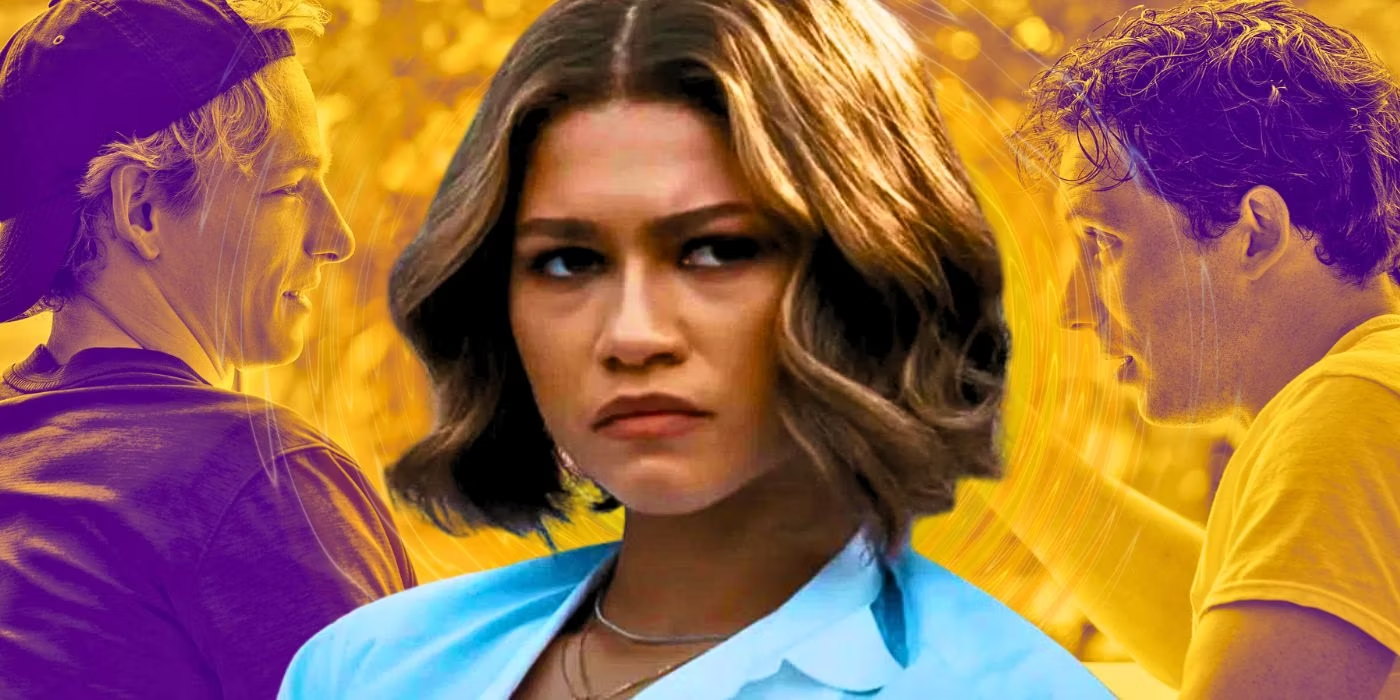
Three impossibly attractive people are at the center of this unconventional but captivating story -- Tashi, a beautiful former college tennis standout sidelined by a dream-killing injury (a radiant Zendaya); who is living vicariously through her struggling husband, Art, whom she coaches and whom she might resent just a little (a soulful Mike Faist of West Side Story); and their old friend, Patrick, an under-accomplished fellow tennis player (a thoroughly engaging Josh O'Connor of The Crown and Emma.) who possesses a powerful serve but more magnetic brio than follow-thru.

The film, imaginatively constructed and shot, pieces together the co-mingling of these three lives over the years, beginning when they were teens on the junior circuit through their mid-30s. It is to their credit that the three leads pull off aging undetectably even as their characters go through marked changes -- some welcome, some surprising.

Guadagnino's flashy on-court set pieces might be a tad over-the-top for some viewers, but I think they are part of the auteur's mission to push the boundaries of narrative and visualization (see A Bigger Splash, Suspiria and I Am Love, for example). I thought they were inspired.

Guadagnino does not avert the camera's eye from naked flesh but makes clear through the characters' actions and words that sex is a tool, and despite being intense lacks true expressiveness and commitment.

This fits because Tashi, Art and Patrick don't seem to be fully able to give themselves over to anything or anyone except what they can't have, which might suggest that no matter how hard they try they'll never be real winners.

Elmer and the executive

  You can hardly blame Elmer and the executive for being cads. Audiences were just too willing to buy their guff. Folks feel good about the ...