Friday, July 22, 2022

Time Enough At Last -- The Twilight Zone (1959)


The 1959 episode "Time Enough At Last" is often cited by fans of the original Twilight Zone as their favorite of the 150 or so produced during the series' run ('59-'64).
For the unfamiliar, Burgess Meredith, who would later famously portray Penguin in the campy Batman television series, played Henry Bemis, a bookish, bespectabled bank teller working for a pesky bank manager and married to a nagging woman both of whom berated him for wanting to do the only thing he really enjoyed -- read.
While Henry is holed up in the bank vault reading during one lunch break, the world is obliterated by atomic blast, and Henry emerges the lone survivor. He wanders the desolate landscape that was once his town and finds no one.
Fearing complete isolation, Henry considers taking his life (with a pistol that appears to have been left over from a Hollywood western) but then sees in the distance the public library is still standing. Oh joy! There he finds all the books he could want to read, now that there's time enough to do so.
He stacks dozens of books on the library steps and begins to settle down to read, but stumbles, knocking his glasses to the steps where they shatter to pieces (quite unlikely considering their thickness but it's television).
The irony, of course, was rich and, apparently, appealed to the Cold War viewing public. Some may have sympathized with Henry's plight; others may have denounced him for trying to check out at a time when the country needed all hands on deck. But who knows?
The episode's popularity has not waned over the years. In fact, some argue it has grown as Rod Serling's dystopic allegory of mid-20th century anti-intellectualism, societal upheaval and the elusiveness of solitude have become 21st-century realities.

The Blue Bird (1940)


Toward the end of Walter Lang's 1940 fantasy The Blue Bird, Shirley Temple, playing a bratty German peasant girl in search of the elusive bringer of happiness, ends up in the Land of the Future with her younger brother, played by fellow child actor Johnny Russell (who, interestingly, like Temple ending up working in the State Department many years later).
In the Land of the Future, they visit with unborn children waiting to be called by Father Time to board the boat fo Earth and deposited into the loving arms of parents waiting for a bundle of joy.
Brother and sister watch as two older unborn children who have fallen in love while waiting for their turn to be born react when one is called to board and the other is not. They weep and wail over being parted. It's all too much for the bratty peasant girl, who is shown with tears streaming down her face.
When she and her brother magically arrive back home (not unlike the sepia-toned conclusion to the Wizard of Oz, the film that The Blue Bird was made to compete with in theaters), the children are no longer spoiled and entitled but bright-eyed and loving. The transformation is quite remarkable!
There's just no end to the wonderful things fixating on the unborn can do!

Nope


Jordan Peele’s approach to story and storytelling is distinctly outré, startling and fresh. Perhaps his biracialism lends him and his films both a cultural specificity and wider social application.
Get Out was about racial annihilation AND spiritual predation. Us was about intra-racial class distinctions AND social stratification. Both told through the lens of sci-fi / speculative fiction.
Peele’s latest film, Nope, is a deliberately paced and seductive space invasion tale set against a background of horse wrangling. Daniel Kaluuya stars as O.J., the son of the only Black horse trainer for Hollywood (Keith David). When his father is killed during a strange rain storm, O.J. and his rootless sister, Em (a delightful Keke Palmer) take over the operation just as the number of strange events around their ranch increases. They eventually figure the source of the peculiar happenings is hiding behind a stationary cloud bank.
With the help of an appliance store skywatcher (Brandon Perea) they prepare to capture the alien (which looks like a Christo installation) on tape and sell the revelation to the highest bidder (Oprah?). The film is about how wrong things go for the trio.
Peele is a thoughtful and insightful creator with a trenchant wit; all of these qualities are woven into Nope, a wonderfully peculiar and puzzling exercise.

The Worst Person in the World


Norwegian writer / director Joachim Trier was nominated for an Oscar this year along with his frequent collaborator Eskil Vogt for the screenplay for The Worst Person in the World (2021), the only foreign language film considered. It lost to Kenneth Branagh's Belfast, a much more cinematically dynamic picture, with a more conventional structure and story arc.

Told in 12 chapters with a prologue and epilogue, "Worst Person" is the story of an emotionally rootless young woman, Julie (Renate Reinsve), who might best be described as chronically indecisive rather than girlishly whimsical, although the latter might be a first impression.
She meets a serious older man named Aksel (Anders Danielsen Lie), the creator of a hardcore comic books series. They make for an unusual couple in his tribe of 40-somethings with children. Julie enjoys Aksel's attention at first but his tendency to condescend wears on her. She gets restless and combative.
One evening on her own, she crashes a wedding reception and meets Eivind (Herbert Nordrum). Despite both being in committed relationships, they flirt and exchange sexual fantasies but refrain from "cheating." Another chance meeting between the two at Julie's bookstore gives her reason to begin to pull away from Aksel.
The break-up conversation is the most probing exchange of its kind I've seen rendered in film. It is alternately wounding and conciliatory. Trier films it with jump cuts and shifting perspectives to reflect the passage of time and the confusion between two highly verbal people, who use words as weapons. A brilliant bit of writing.
Julie's life with Eivind seems to offer her some of what living with Aksel lacked, most particulary someone who held as little interest in self-reflection as she did. That's not to say this pairing would be any more satisfying, for Julie is without clear definition or purpose, which is why she skates through life, endearing herself to others at one turn and tearing herself away at the next.
All three principal players are terrific in these interior roles, and Trier knows how to make room for ambiguity. All three characters are well acquainted with uncertainty and how difficult that makes recognizing when you're happy. (Hulu)

Monday, July 4, 2022

The Cider House Rules (1999)


For The Cider House Rules (1999) Lasse Hallström worked from a screenplay by novelist John Irving of his own sprawling work, which depicts all manner of human trials, including agonizing over unwanted pregnancies.
At different points in the film, two women -- the spirited Candy (Charlize Theron), the daughter of a Maine lobsterman, and Rose, the daughter of the crew chief of migrant apple pickers (Erykah Badu) -- face unwanted pregnancies. Candy's is presumably through sex with her WWII fighter pilot boyfriend Wally (Paul Rudd) and Rose's through sex with her father Mr. Rose (Delroy Lindo).
Candy's pregnancy is terminated, illegally, at the clinic by the wilfully compassionate Dr. Larch (Michael Caine) and his relucant assistant and "adopted son" Homer (Tobey Maguire), a young man barely out of his teens. Homer, who has only known life in the orphanage and the clinic, objects to abortions but is committed to "being of some use in the world."
Homer soon leaves the orphanage with Candy and Wally and joins a crew of migrant apple pickers in Wally's family orchards, where he meets the spitfire Rose and her congenial but controlling father, Mr. Rose (Delroy Lindo). When Homer notices Rose growing listless, depressed and frequently ill in the morning, he discovers she's been impregnated by her father. Homer confronts the man, who warns him to mind his business. But the young man, telling them of his medical training, prevents Rose from performing an extraction on herself, quite possibly saving her life.
That Hallström's film is moral without being moralistic is one of its strengths -- it's also beautifully shot with many superb performances. The tone is not preachy or reductive but profoundly human and intimate, recognizing we are not perfect, mistakes and bad decisions are parts of life, and often the rules that are forced upon us -- like those posted in the bunkhouse for the migrant apple pickers -- are written by those who know nothing about us or our worlds, though they would pretend to.

Albert Ayler


My observance of Independence Day has moved away from patriotic celebration to meditations on the spirit of freedom and some of the persons who I feel embody it.
Free jazz saxophonist Albert Ayler (1936-1970) was so unbought and unfettered in his unorthodox approach to playing his instrument that he never found an audience during his short career beyond ardent fans like jazz pioneers and innovators John Coltrane and Don Cherry. I find his work endlessly fascinating and transporting despite its challenging structures.
Ayler was born in Cleveland but had his greatest success (relatively speaking) in Europe, making his first recordings in Sweden in 1962. The following year, he relocated to New York and was soon signed by the experimental label ESP-Disk, which released his classic record Spiritual Unity, which might be the best loved of Ayler's albums (again, relatively speaking).
Ayler's music is difficult -- atonal and arrhythmic. His most familiar compositons begin with him playing alto or tenor saxophone phrases from hymns or other spiritual songs, military marches or children's ditties and then spinning wildly into cacophanous improvisations, on early recordings accompanied by bass and drums, but later with piano, other saxes, trumpet, spoken word and singing.
Though there have been about 30 releases of Ayler's recorded music (studio work, concerts, compilations), not one of them has sold well. He remains an acquired taste, an elusive, uncompromising artist with stark vision of what music should be, how instruments should sound.
Because of this commitment to a singular vision, Ayler lived a penniless existence until his tragic death in 1970. He disappeared from his home in early November and his body was pulled from the East River more than two weeks later, a presumed suicide.
Toward the end of his life, Ayler showed signs of emotional disturbance and dissociation even as his music was growing more accessible, leaning toward the more R&B and rock 'n' roll stylings of his youth without completely abandoning his free form vitality. His last live sessions were in France four months before his death, recordings from these performances were finally released last month, nearly 50 years later.

The Black Phone


The 'tweener siblings at the center of Scott Derrickson's Stephen Kingsian chiller The Black Phone -- bully magnet Finney (Mason Thames) and mouthy badass Gwen (Madeleine McGraw) -- are growing up in Denver in 1978 surrounded by violent schoolmates and adults who are either clueless or menacing.
We meet them during a string of teen boy abductions, about which sister Gwen appears to receive messages in her dreams. This enrages their drunken father (Jeremy Davies), who orders the girl during a lashing to forget about the visions because they only bring trouble.
When Finney himself is kidnapped by The Grabber (a wonderfully masked Ethan Hawke), he discovers in his basement prison the eponymous telephone, which is connected to the realm where previous victims dwell. Most of the movie's action involves Finney receiving ghostly guidance from the other victims, trying to avoid their fate, and sister Gwen praying, sometimes with artful profanity, for help from heaven as she pieces together clues from apparitions.
The sharpness of these two young actors and Hawke, who never disappoints, makes up for some shortcomings in the film's narrative, which is based on a story by Joe Hill.
Essential questions about The Grabber's motives and the spirit world connections suggest that the story is not a fully realized supernatural tale but an allegory for a boy's coming of age, when he finally finds and defends himself.

Monday, June 27, 2022

Rosemary's Baby (1968)


Director Roman Polanski's Rosemary's Baby (1968) is noteworthy because it creates dread by peeling away the viewer's presumptions and defenses as they watch Rosemary (Mia Farrow) slowly compromised and subdued by those she trusts, including her husband (John Cassavetes), her kindly neighbors (Ruth Gordon and Sidney Blackmer) and her highly respected obstetrician (Ralph Bellamy).
While the film is sometimes categorized as a horror picture, it really isn't, at least in the conventional sense of horror. It contains little blood and no boos. The devil makes a crucial cameo appearance but he's mostly claws and glowing eyes. We are frightened for Rosemary and not by monsters under beds or in closets.
Polanski's more important work -- this film, Chinatown, The Pianist, Knife in the Water, Repulsion -- are character studies. Rosemary's Baby is carefully constructed to hide the real evidence of evildoing. It sets the fear squarely in Rosemary's mind. She is traumatized by the death of a new acquaintance and by troublesome early pregnancy pains. She cobbles together clues left by her one trusted friend (Maurice Evans), who mysteriously falls ill after urging Rosemary to be careful.
Even the fairly graphic (for 1968) satanic rape scene might be construed as a nightmare brought on by too much drink and rich food -- chocolate "mouse." Is Rosemary mad (pre-partum psychosis) or are there really witches living all around her? The last reel of the film lays it all out fairly plainly. Or does it?
The picture has particular relevance now -- at the beginning of the post-Roe era -- because it frightens and unnerves audiences to see a woman, who dearly wants to give birth, lose control over her uterus, carry to term a child of rape, and then succumb to the pleadings of others to care for it -- after all, she is the mother.

Saturday, June 25, 2022

A Strange Loop


Broadway is a bit out of reach for me, right now, so exploring the wonder that is the Tony Award-winning musical A Strange Loop has been limited to Spotify.

The show by Pulitzer Prize winner Michael R. Jackson is a torrid and tuneful treatise on race, religion and sexuality, that uses these constructs as both social phenomena and metaphors.
The main character, presumably Jackson's alter ego, is a theater usher named Usher (Jaquel Spivey), who is struggling with his identity and with his creative voice, which he feels is stifled because he is a Black gay man who feels disassociated from all of these things, his family and the theater world.
Usher interacts with a chorus of a half-dozen singers, also identified in the lyrics as Black and queer, who at various times play his conflicted thoughts, disapproving family members, random sex partners and other associates in Usher's life.
Jackson's songs are complex and narratively dense, the language might be startlingly frank for some listeners but the vulgarity is not gratuitous; it is rooted in the story's world of sexual repression, anger and falseness.
Those who admire the work of Hollywood A-lister Tyler Perry might find Jackson's labelling the actor/director/producer as a low-balling hack (my words) is unfair. But as one who agrees with Jackson's assessment of the mogul, I think Perry's world is a powerful emblem of Usher's predicament. That is, Usher can't be who he is, a Black queer man, when the model of Black male theatrical success is a man whose world denies Usher's reality and demands that he conform or resign himself to obscurity.

Zardoz


In the opening scene of writer / director John Boorman's Zardoz (1974) -- after a kooky prologue by a mysterious narrator of sorts -- a floating stone head with fierce shining eyes and gaping mouth descends on a group of masked horsemen, spews out rifles and handguns and orders the riders to kill the lesser brutes in the countryside.

The men bow and shout "Hail, Zardoz," grab up the weapons and remount. All except one unmasked, pony-tailed fellow who turns, pointing a pistol at the camera. He is revealed to be a mustachioed Sean Connery in blood red bikini shorts and a bandolier -- not a good look. He fires a single shot at the viewer, ala the introduction to a James Bond feature. (By '74, Connery was done with the Bond series with Diamonds are Forever ['72] -- that is, until '83's Never Say Never Again.) His performance as Zed the brute is so wooden and unconvincing, one wonders why he bothered to take the job.
One of Boorman's least impressive offerings -- remember Boorman directed Deliverance and Hope and Glory -- Zardoz is wildly ridiculous, brimming with hippy mumbo-jumbo, trippy psychedelia and flower-child costuming. But it also carries some interesting ideas about science and intellectualism, violence, sexual repression, classism and war.
Some of these messages are packaged better than others and the big surprise 3/4 of the way through might have some folks groaning (the secret is in the film's name) but the movie is worth a rewatch, particularly for its treatment of religion, orthodoxy and mind-control.

Elvis


Aussie director extraordinaire Baz Luhrmann anchors his dazzling Elvis in the terrific dynamic between Austin Butler's uncannily accurate / swivel-hipped performance as the King of Rock 'n' Roll and Tom Hanks' more nuanced but riveting portrayal of the gambling-addict Svengali who took the handsome, honey-voiced son of Tupelo and turned him into the "most famous person in the world" -- the enigmatic Col. Tom Parker, narrator of the story.
Were the film just about the rise and fall of an American musical legend -- all exploits and exploitation -- that would likely be plenty for most of those drawn into the theater by the film's title. But, to this viewer, the picture contains grander notions, namely, how popular cultural phenomena reflect and foment social change.
Elvis's fairly brief but jam-packed 20-year career ran parallel to seismic changes in American history -- the Civil Rights Movement, the Vietnam war, youth rebellion against establishment values, the outsized power of television -- and Luhrmann folds into the story how these events were refracted through the eyes of Elvis, who was struggling with trying to be true to himself while pleasing those around him.
Luhrmann proffers that rather than being an appropriator of Black culture, Elvis was never more honest to himself than when he was singing the music he heard as a child -- gut-bucket blues and Negro spirituals. Scenes of an ecstatic young Elvis moving in the spirit in a Black country church and his taking in Beale Street acts with his friend B.B. King (Kelvin Harrison Jr.) appear to be intended to challenge claims that Elvis was a poser who made millions through cultural theft.
The picture is robust and visually breathtaking, just as one would expect from the director of Moulin Rouge. Butler's turn as Elvis is the showier performance but Hanks' as the jowly, curiously accented Parker is the stronger, to me, because so much of the movie's vitality is invested in the oily machiavellian, who even when threatened with termination or explusion manages to survive to play another hand.

Tuesday, June 14, 2022

The Guilty / Ambulance


In his two most recent movie releases, Jake Gyllenhaal plays characters on opposite ends of the criminal justice continuum. But both the 9-1-1 dispatcher in Antoine Fuqua's The Guilty (2021) and the serial bank robber in Michael Bay's Ambulance (2022) have tenuous grips on sanity, giving further evidence (along with 2015's Nightcrawler and 2016's Nocturnal Animals) that Gyllenhaal, 43, has become a master of madness.
The Guilty, an adaptation of a 2018 Danish film, is ostensibly a solo performance for Gyllenhaal, as most of his co-stars are off-screen voices of people Gyllenhaal's Joe Baylor is either trying to assist or to detain as he draws conclusions about and misinterprets a domestic disturbance call from a child on the night before he is to appear in court for reasons the viewer only discovers late in the picture.
Gyllenhaal's flinty character's unraveling is distressing to watch; he's a bundle of raw nerves, lashing out at others and tearing at his own feelings of entrapment. And Gyllenhaal eviscerates like no other actor. Fuqua, who directed Gyllenhaal in 2015's Southpaw, pulls an impressive performance from the actor while weaving a compelling redemption story set against a cold L.A. cityscape.
Bay puts the same cityscape to more practical use as Gyllenhaal's Danny Sharp and his adopted brother Will (Yahya Abdul-Mateen II) flee from a legion of L.A.'s finest on wheels and in the air during an epic chase after a botched downtown bank robbery.
Against his better judgment, Will joins Danny's crew at the last minute to score enough money to pay for a much-needed operation for his wife (Moses Ingram). Complicating the brothers' escape is an EMT(a terrific Eiza González) whose ambulance they commandeer while trying to escape. Inside the ambulance is a policeman Will had earlier shot while fleeing the bank.
Bay's films are brawny, intricate and excessive, but also often tonally and narratively complex. This is certainly true for Ambulance, which is heavy with characters and their emotional baggage -- some adding comedic spice, others layers of pathos.
While Gyllenhaal and Abdul-Mateen are well-matched as childhood mates who later become brothers, the wattage of Gyllenhaal's performance often outshines others on the screen. Which I suppose is the definition of being first on the call sheet.

Crimes of the Future


David Cronenberg’s second pass at his own story titled Crimes of the Future opens with a filicide and then gets pretty disturbing — but not as icky as several of the uncompromising director’s earlier films — The Fly (1986), Naked Lunch (1991) and eXistenZ (1999), for example. This might be more a factor of the rest of moviedom pulling out the stops on viscera more frequently than with any change in Cronenberg’s particular vision. He’s still the master of revulsion in this story of a future time when humans develop immunity to pain and substitute scalpel-play for sex.

The hero of this tale is a shrouded figure named Tenser (Viggo Mortensen), who grows new internal organs but whose body appears seriously compromised, unable to process discomfort or digest food.
He and his partner Caprice (Lea Seydoux) have a popular organ extraction cabaret act that has attracted the attention of a weirdly repressed organ registrar (Kristen Stewart) and her twitchy companion (Don McKellar).
You know you’re in Cronenberg World when the funniest exchange is one character saying another character is creepy. But the movie’s sardonic take on human dystrophy is both potent and timely.

I'm Thinking of Ending Things


Writer / director Charlie Kaufman's surrealism is more provocative, potent, and, at times, ponderous than that of more prolific and nimble eccentrics like Paul Thomas Anderson or Wes Anderson.
Kaufman's movies -- Being John Malkovich, Adaptation, Eternal Sunshine of the Spotless Mind, among them -- are punchy contemplations of the struggle to be fully whomever it is we are and how that struggle is complicated by other people.
Kaufman's characters -- I suspect to one degree or another alters to his ego -- wrestle with ideas, not all of them original notions, that frequently are left unresolved but nonetheless thoroughly examined -- thus the sometimes ponderous nature of his work.
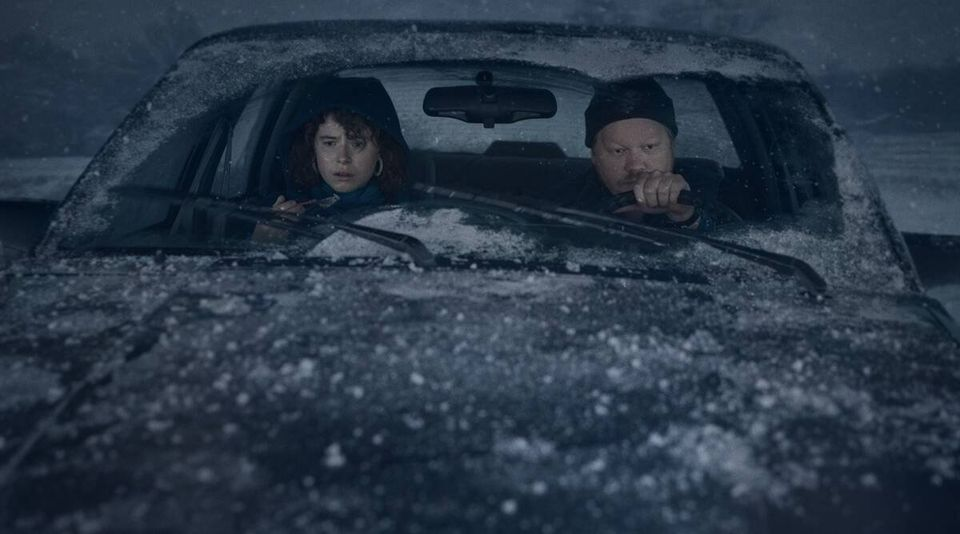
"I'm Thinking of Ending Things" is not as one might suspect about suicide, necessarily. It is ostensibly a two-character consideration of ambivalence. A young woman played by Jessie Buckley and her boyfriend, Jake, played by a never-better Jesse Plemons, are on the road in Oklahoma during a snow storm to visit Jake's parents, played by David Thewlis and Toni Collette, at their farmhouse.
During the home visit, the four characters seem to shift in time and space, with the parents appearing at different ages and in different stages of infirmity. The young woman, the dominant POV, falls into playing whatever role the situation demands even though she doesn't want to be there, with her boyfriend and having to contend with his or his parents' issues. The young couple's erudition belies their surroundings and circumstances; they are extraordinarily insightful and articulate but also guarded and uncertain.
Interspersed with the home visit are scenes of a high school janitor (Guy Boyd) cleaning the hallways while a production of Oklahoma is being rehearsed. The final reel of the movie brings these elements together but the getting there is a bit of a slog, and the ambiguity of the movie's ending will no doubt spark all manner of speculation among those who were arrested by Kaufman's idiosyncratic vision.

Friday, June 10, 2022

Fantastic Beasts: The Secrets of Dumbledore


David Yates could direct a Harry Potter Wizarding World film in his sleep, and part of me feels Fantastic Beasts: The Secrets of Dumbledore came together during periods of slumber.

The series -- which has starred most regularly Eddie Redmayne as the magizoologist Newt Scamander and Dan Fogler as the earthy mortal Jacob Kowalski -- is a peculiar variety of action fantasy film.
The titular magical critters are indeed fantastic and, I suspect unwittingly, exude more personality than their human co-stars, especially Jude Law as the conflicted Albus Dumbledore, who finds himself opposing in battle his former love interest, the epitome of wickedness Gellert Grindelwald (Mads Mikkelsen).
The picture's core intrigues want to parallel real-world contestations -- both romantic and international -- but, for me, they failed to captivate because they too often verged on silliness, and the pacing never lifted the film out of the narrative doldrums of the familiar -- same worries, different day.

The Northman


Robert Eggers has directed only three feature films, each more exceptional than the one before. The Witch (2015) introduced many of us to the doe-eyed Anya Taylor-Joy and to Eggers' fascination with mysticism as a theme and surrealism as a tonal approach.
In 2019, Eggers' The Lighthouse's two-character tour de force (if one doesn't count the lighthouse itself) continued in the stylistic vein of its predecessor while introducing psycho-sexual undertones in a stunning tale of obsession and madness.
His latest, The Northman (note Eggers' minimalistic approach to film titling), combines all of the elements of the first two features in a re-staging of the Norse legend that gave Shakespeare's Hamlet its theme and rough structure.
Alexander Skarsgård stars as Amlet, the son of a murdered chieftain (Ethan Hawke) in primeval Scandinavia, who pledges vengeance against his uncle (Claes Bang) for killing Amlet's father and marrying his mother. While hiding from his uncle's men, Amlet grows into a fierce, barbaric warrior, untouched by human emotion, his only thought being getting close to his uncle so that he might kill him and free his mother (Nicole Kidman).
Along the way, Amlet is aided by various witchy seers (mainly a freakish Bjork, which might be a redundancy) and a young enslaved woman with her own plans for vengeance (Taylor-Joy).
While The Northman's battle scenes are numbingly grisly, the film as a totality is visually outstanding and not without a few narrative twists. Amlet's reunion with his mother might well earn Kidman a few nods come award season.

Heartstopper


Netflix's British teen romance Heartstopper is the sweetly affirming story of two teen-aged schoolboys -- one a bullied, recently outted drummer named Charlie and the other a bi-curious rugger named Nick -- who meet cute one day in a class and discover their mutual attraction.
The eight-episode series stars Joe Locke as Charlie and Kit Connor as Nick and a host of other young actors as their constellation of friends, each dealing with their own matters-of-the-heart. Based on the Heartstopper graphic novels by Alice Oseman, the series features stylistic animated touches -- flurrying leaves, floating hearts, sparks -- that lend juvenilized accents to the narrative's charmingly inoffensive young-adult territory.
The two leads inhabit different emotional landscapes as their friendship becomes increasingly central to their evolving identities. In fact, the relationships among the various characters, while highly relatable and touching, serve as devices to examine the development of young people across sexualities and gender identities.
And the paucity of adults in the series -- aside from a few supportive parents and teachers -- means the story's focus is on the young people. The narrative gaze is not parental or academic, but, in many ways, clear-eyed and uncynical.

Wednesday, June 8, 2022

Charlotte Rampling


I really like Charlotte Rampling.

She's 75, a member of England's upper crust, and an OBE.
She was quite the dish as a young model and actress, sexy and scampy.
She's made dozens of pictures since her anonymous debut as a dancer in The Beatles' A Hard Day's Night in '64.
She doesn't take easy parts. Mostly art house fare -- 'Tis Pity She's a Whore, Zardoz, Melancholia.
She's chalked up a few hits -- The Verdict, Angel Heart, Stardust Memories. A television series here and there -- Dexter, Broadchurch.
And was nominated for an Oscar for 45 Years in 2016.
But nothing has been as enormous as Dune, in which she performs all veiled and ominous.
I really like Charlotte Rampling.

Top Gun: Maverick


Tom Cruise was 24 when Top Gun was released in 1986, a time when he was only just beginning to become one of Hollywood's more bankable faces.
In director Joseph Kosinski's sequel, Top Gun: Maverick, Cruise, a robust 60, is still the incorrigible navy fighter pilot of the earlier film but now he's grown wiser, and though his sculpted face shows no signs of worry, the ace is burdened by regret.
Both movies feature thrilling jet plane aerial sequences but it's the new picture's emotional complications that lift it above the original, directed by Tony Scott. These complications extend from the troubling events of the earlier film (revisited in flashback) and presumably from other incidents involving bar owner Penny (Jennifer Connelly) that transpired in the interim.
The earlier movie invested a lot in Cruise's considerable charm, Kelly McGillis' gender-role-busting aviation-consultant-in-heels, and the smoldering swagger of Cruise's leading co-stars -- Anthony Edwards as his co-pilot Goose, and, of course, Val Kilmer as Maverick's cocky competition for team leader, Iceman. (Kilmer, who has been rendered voiceless by cancer, makes a cameo appearance in the new picture.)
Top Gun was crafted around a fairly conventional "failure and redemption" storyline, but had a rocking Top 40 soundtrack (Take My Breath Away won the Best Song Oscar in '87.) The picture was an enormous hit for Paramount.
To the new filmmakers' credit, Maverick's layered narrative enhances the movie's familiar tale of a ragtag team of talented incompatibles brought together by an unlikely and reluctant agent (Cruise). The pilots -- all young and fashion model pretty (that hasn't changed) -- are dispatched on an impossible mission (pun intended) against a nuclear facility being readied by an unnamed enemy (don't want to hurt the film's foreign markets).
As a nice touch, Maverick's relationship with the young pilot Rooster (Miles Teller), the orphaned son of Maverick's late friend Goose, is revealed gradually, as the two square off early but are forced by circumstances to set aside their lingering pain and resentment for the sake of the mission.
Top Gun: Maverick is successful because nothing -- except the aerial maneuvering -- feels overplayed. Even Cruise, a showboater from his youth, is pretty restrained in a picture that is being released into a different public space than what existed during the Reagan '80s.

The Bob's Burgers Movie


Directors Loren Bouchard and Bernard Derriman turn the outrageous, chinless humor of Bouchard's animated series Bob's Burgers into a laff riot with music in The Bob's Burgers Movie. It's an animated feature so densely packed with killer lines that I feel it's a no-brainer for immediate rewatch.
The film opens with a shadowy murder at a pier carnival, after which the audience is introduced to the stars: Beta-male Bob (voiced by H. Jon Benjamin) runs an artisanal burger joint near the pier with powerhouse wife Linda (voiced by John Roberts) and with the occasional assist from their three neurotic school-age kids -- Tina, Gene and Louise (Dan Mintz, Eugene Mirman and Kristen Schaal, respectively).
Business is slow. Rents are due and prospects are bleak. Then a sinkhole opens just outside of Bob's, skeletal remains are discovered by spunky-but-developmentally arrested Louise and all events begin to merge with those in the opening sequence.
No question, utter nonsense, but there are narrative gold nuggets, too -- Tina's improbable crush on a nasally classmate, Gene's ridiculously uninspired idea for a garage band, Louise's traumatic bunny-ears backstory, Linda's smothering motherliness that feels both affirming and toxic, Bob's seeming total lack of heroism, and three completely whack musical numbers that might not have the audience humming after the credits but are showstoppers nonetheless.
It's a "family" movie in all the wrong ways but is so much fun.

Eagle Eye

  In 2008, D.J. Caruso directed an AI-gone-rogue thriller that starred real-world PITA Shia LaBeouf and the always welcome Michelle Monaghan...