Tuesday, November 18, 2025

The Running Man (2025)


Edgar Wright's remake of Paul Michael Glaser's 1987 adaptation of Stephen King's The Running Man amps up the social / political commentary, which increases its relevancy but might detract from its longevity.
Hollywood looker Glenn Powell takes on the Arnold Schwarzenegger role of Ben Richards, the title character who competes in a televised race against the clock. Powell's Richards is one of the teeming masses living in slums, cut off from meaningful employment, decent housing and adequate healthcare. (To say the narrative is pointed would be a cheeky understatement.)
Unlike Schwarzenegger's disgraced police officer seeking reinstatement, Powell's Richards is a flinty, black-balled industrial worker who was punished for caring about his fellow laborers. He is looking to make enough money to afford real medicine for his sick daughter and move the family out of the slums.
The corporate / state entity runs sadistic contests in which the poor compete for money in front of studio audiences. Richards promises his wife, Sheila (Jayme Lawson of Sinners), that he would not apply for the big payday, The Running Man. This show is hosted by Bobby T (Colman Domingo) and as heavily edited / fabricated reality TV. But Richards is persuaded by the greasy network chief Dan Killian (Josh Brolin) that his fiery temper would get him across the finish line and into a better life.
The movie is a race against time -- a frequent narrative trope since the '87 flick. Lethal hunters, led by the masked Evan McCone (Lee Pace), are on Richard's tail, using all manner of surveillance and public crowdsourcing to track him. (Ditto with the comment on social / political relevance.)
Richards discovers on his journey toward the finish line underground fighters (William H. Macy, Daniel Ezra, Michael Cera) at work undermining government control and propaganda. They help Richards stay a step ahead but, of course, there must be a final showdown.
Though there's little doubt Richards will survive his ordeal, the future of the other millions is left uncertain -- as is true for those of us in the real world of the movie audience.

Nuremberg and The Mastermind


James Vanderbilt's Nuremberg is an interesting but not fullyu satisfying approach to the much-visited subject of the trial of the surviving Nazi high command after Germany's surrender in 1945 and the death of Adolph Hitler.

Vanderbilt's picture, based on The Nazi and the Psychiatrist by Jack El-Hai, is a character study of U.S. Army psychiatrist Douglas Kelley as played by Rami Malek and Reichsmarshall Hermann Göring, a dedicated Russell Crowe.

Vanderbilt has written an often riveting battle of wits and wills between the self-assured (and self-interested) Kelley and the imperious Göring, as the psychiatrist tries to crack the Nazi mindset.

Kelley is asked by the head of the Nuremberg multinational tribunal, US Associate Justice Robert Jackson (Michael Shannon), to share his insights and analysis with the prosecution team, but Kelley refuses, at first. He hopes to keep whatever he finds during his interviews for later publication. What develops is a strangely symbiotic friendship with Göring, including carrying letters between the German and his family.

Kelley is aided by Army translator Sgt. Howie Triest (a nicely tempered performance by British actor Leo Woodall), who translates interviews between the psychiatrist and the prisoners and offers Kelley invaluable insight of his own. It's Triest's monologue near the end of the picture that lands most compellingly for the viewer.

Though Vanderbilt includes devastating footage of the concentration / death camps taken by Allied Forces during liberation -- including the disposal of mounds of corpses -- the picture falls short of convincingly depicting the monstrosity of the Reich and the men who led it.

Part of the problem is casting the affable Crowe as Göring. Kelley (and, ergo, the film) suggests Göring's enormous self-regard -- depicted in the scene when his escaping car is stopped by American soldiers and he asks them to get his luggage -- made the man incapable of harboring malice toward anyone -- including Jews. He simply did not care about anyone but himself. This is an interesting -- but unpersuasive conceit.

++++

Kelly Reichardt's The Mastermind gives the reliably fascinating English actor Josh O'Connor an opportunity to fully own a picture that plumbs the depths of a character who appears to have few redeemable qualities but manages to convince others to follow him into disaster.

O'Connor's James Mooney is an unemployed Massachusetts cabinet-maker, husband and father of two, son of a judge and art thief in 1970. An unkempt and morose figure, James plans the theft of four abstract pieces from the local museum with three accomplices Larry, Guy and the spitfire Ronnie (Eli Gelb, Cole Doman and Javion Allen, respectively).

The heist is both bungled and successful, with James getting away with the paintings and storing them in the loft of a barn outside of town. When Ronnie gets arrested during a bank robbery, he fingers James as the "mastermind" of the museum job, which leads to James sending his family (Alana Haim and Sterling and Jasper Thompson) to stay with his parents (Bill Camp and Hope Davis) and him hitting the road.

James's desultory wanderings to avoid capture reveal, slowly but wonderfully, the depths of disconnection with the world around him. Though others appear to be drawn to him -- like his starstruck friend Fred (John Magaro), James shows little but the most pragmatic regard for other people, includin ghis wife and children.

And yet, it's difficult to dislike this character. He's so pitiful in his deception that the viewer's heart goes out to him -- which, of course, in real life is how people like James Mooney get through life.

Monday, November 3, 2025

News, Newspapering and New York City


At the turn of the 20th century, New York City was a news mecca, home to a score of daily and weekly newspapers with names like The Times, The World, The Journal, The Herald, The American, The Sun, and The Post.

Literacy amongst white folks in the U.S. was about 90 percent then; 55 percent among Blacks and other people of color nationwide, although one would expect that percentage was larger in urban areas in the Yankee North.

New York was a readers' city, and newsstands offered something for everybody. The Times was the straightlaced newspaper of record (The Old Gray Lady), Pulitzer's World and Hearst's Journal waged wars of sensational yellow journalism, The Herald spun people stories, and The Post spouted Hamiltonian conservatism.

In fact, many general circulation newspapers were politically aligned or at least party sympathizers well into the 20th century.

Partisanship was eventually cooled by market forces that shifted the newspaper's revenue stream from readers to advertisers. Advertisers wanted to reach as many eyeballs as possible, so the newshole became more neutral, and viewpoints moved from the front page to editorial.

In addition, the rise of professional journalism schools infused newsrooms everywhere with staffers trained in the same standards of objectivity that had shaped news service reporting since the 1830s.

Later changes in market forces altered the landscape again and laid waste to legacy media. These changes left public officials under-scrutinized and the general public under-served. Partisan media resurged in social media fragmentation.

That the regime has no truck with traditional journalism practices, choosing to propagate misinformation through social media, and has stacked the White House Press Corps with conservatives surprises nobody who has been paying attention.

It's good that many journos still bristle at charges of bias or "fake news" from a regime shamelessly dedicated to both. But they should not feel compelled to defend themselves in the face of such bad faith.

Rather, adopt the demeanor of the Old Gray Lady when labelled such by its flashy, sensationalistic neighbors. Stay the course and outlive them.

Friends and Baggage


It occurred to me that we are a thoroughly transactional society -- more than I once thought.

While some folks still use language like "relationships," more and more of us are using words like "connections," even when talking about our families and closest associates.


Transactional friendships can be compared to traveling with luggage.

For example, our wallets and billfolds are kept close, like intimate friends, and we feel disoriented when we discover they're absent. Panic might even set in.

Other friends, important but not as indispensable, are like carry-ons that we stow nearby, still needed and accessible, but we're comfortable with their absence for a while. We reach for them for amusement and diversion and then put them away again.

Other friends are like the luggage we check at the gate or with baggage handlers. We grow frustrated when they aren't where we need them to be, but we'll make due, and if need be we will acquire replacements if they don't turn up.

When a bag is permanently lost, the traveler might learn an important lesson about themselves and their priorities and attachments and might make better decisions going forward.

Toni Morrison's The Bluest Eye


Scientists tell us that 3/4 of the world's population has brown eyes. About 9 percent, blue, and the rest of the colors -- hazel, amber, grey, green etc. -- are distributed in lesser and lesser proportions around the globe.

But fictional heroes and heroic figures in Western literature and visual media almost always have blue eyes. Even common emjois have blue eyes. Seems improbable considering the data, but there it is.

This is changing with the darkening of popular culture, but blue, especially among females, is still the preference.

In her book The Bluest Eye (1970), Toni Morrison distilled predominant beauty standards down to the color in the title. The main character, the young Black girl, Pecola, is driven mad by the oppressive and arbitrary assignment of desirability and value in her community of Lorain, Ohio, which, of course, is a simulacrum of American culture.

Morrison's book has been removed from school libraries all over because of its uncompromising depiction of human destructiveness, not just racism and colorism, but physical, emotional and sexual abuses. She even explores pernicious religious fraudulence as it preys upon Pecola's gullibility, promising miraculous physical transformations for a price.

Morrison, whose brilliance as a storyteller was celebrated with multiple awards, including the Nobel Prize, was never as gauche as to turn the elegant prose in her novels into polemical screeds. Her work is much too elegant and refined for such base amateurism.

Rather, she excoriated systemic racism and cultural bias, sexual hypocrisy and misogyny and fraudulence in stories that were never told conventionally but inventively, surprisingly and searingly.

Attacks on her vision might appear, through some folks' eyes, as unimportant in light of other pressing concerns. But I think it is part of the overall scheme to delegitimize anything -- no matter how exquisitely crafted -- that might awaken our consciousness, remove the scales from our eyes, as it were, and help us see what is being done, and ask "why?"

Cameron's Feminism


You know that scene in James Cameron's Aliens (1986) when Lt. Gorman (William Hope) -- the leader of the expedition of Marines to the planet that Ripley (Sigourney Weaver) has warned is overrun with ferocious skeletal xenomorphs that incubate in human bodies -- freaks out because he's in waaaaaay over his head. Personnel are being wiped out left and right and his simulator training wasn't enough to prepare him for the real world?

At that pivotal point, Ripley (a role that earned Weaver an Oscar nomination, bitches!) steps into the gap left by Gorman's breakdown and is able to save the remaining members of the expedition -- for the time being -- and even offers Gorman the chance for redemption.

Well, ALL of the current administration, not just the "War Department," is Gorman -- dithering, mumbling, blathering about "spit and polish" and readiness and sucking it up and on and on and on.

We've reached the point -- seems like it's been a few light years, frankly -- where leaders disappoint and demoralize those directly reporting to them and the rest of us on the regular. They're not up to the challenges of true leadership. Talking and pretending are NOT meaningful action. It's almost like their understanding is rooted in television. Peter Weir's The Truman Show (1998)? 🤔

Those of us who are still invested in this country's future -- and have not checked out either physically or emotionally -- are waiting for a reality check to set things aright.

In my book, James Cameron is an uber-feminist. The array of powerful women at the center of his epic adventures is impressive and in many ways inspiring -- Ripley in Aliens, Lindsey in The Abyss, Neytiri in Avatar, Helen in True Lies, Sarah in The Terminator, etc.

Maybe turning the wheel over to women (or even capable men, for that matter) who know what they're doing, are clear-eyed and focused and not blinded by their vanity to the distresses they're causing would be the way to go.

Sure, basing real-world decisions on Hollywood mythologizing can be dangerous, but can it be any worse than what we've got?

Sunday, November 2, 2025

Who Mourns for Tyrants?


In the famous Star Trek episode "Who Mourns for Adonais?" (S2, E2), the actor Michael Forest played an alien being claiming to be one of the gods from Earth mythology, Apollo. He lives alone on a planet the crew of the Enterprise is exploring because of its familiar Greek structures.

When the landing party arrives, Apollo welcomes them to "Olympus" and after dispatching two dispensable landing party members (as was the pattern in this series), he tells Kirk (William Shatner) to order the rest of the crew to transport down, take apart the ship to make their homes and worship him for all of their days.

Apollo takes a shining to a female member of the landing party, an archeologist played by Leslie Parrish, turning her head with divine adornments.

He's confused when Kirk refuses to comply and doesn't understand why these lesser beings wouldn't rush to please him. The inevitable showdown between god and human comes after the pretty archeologist tells Apollo she was not really taken in by his flattery. She was studying him as if he was an interesting alien species. Ouch.

Apollo is finally defeated when the Enterprise destroys the source of his great power. He fades away, literally, having now lost the second thing that kept him alive -- the first being human adoration.

Tyrants live mostly in their own imaginations, picturing what a life of endless affirmation would be like. They panic when faced with reality, represented by the resistance or resentment of those they are trying to impress.

All tyrants, in time, become one with the dust, like the rest of us. No more and no less.

The Irony Age


I was sitting on a bench across from the Monument to Desegregation outside of the McKissick M\
useum at USC yesterday when a diminutive instructor with a piercing voice led a group of students up to it.

The instructor -- probably a graduate student, probably Middle Eastern as noted by her appearance and accent -- made a point of telling the class they were not interested in the bronze figures, just the base of the monument. They could read what it was about elsewhere. She asked them what minerals seemed to be present in the base, directed them to their study sheets, and walked them through a visual analysis.

Clear and precise instruction, yes, but it struck me as curt and dismissive of the significance of the statute. I wondered if, in light of the current political climate, instructors -- perhaps those most vulnerable -- have been instructed to steer clear of anything that might lead to trouble with Big Brother, that might be reported by an anti-woke crusader in the class, that might bring ICE knocking at doors?

Since we are in the Irony Age, I did not fail to note that these questions came to mind in front of a memorial to openness, in front of a museum dedicated to cultural awareness, in a structure that once was the storehouse for the university's collected knowledge. Pity.

Saturday, November 1, 2025

Exhibiting Forgiveness


Like the artist at the center of his Exhibiting Forgiveness, director Titus Kaphar pours memory and pain onto a large canvas, invites the world in and leaves it to the viewer to create sense and connection with the work.

The film -- which stars André Holland, Andra Day, John Earl Jelks and Aunjanue Ellis-Taylor -- brims with emotion as a family struggles against a history of abuse and addiction to find healing and peace. The answers are not easy and terrain is rocky and is guaranteed to leave many viewers bruised and exhausted. But also, well, blessed.

Albee's American Dream


The title character of Edward Albee's 1961 surreal one-act The American Dream -- a young, virile but seemingly vacuous young man -- says in his speech toward the end of the play that he was born with an identical twin from whom he was separated at birth.

"We were torn apart, thrown to opposite ends of the continent. I don't know what became of my brother ... the rest of myself ... except that, from time to time, in the years that have passed, I have suffered losses ... that I can't explain. A fall from grace ... a departure of innocence ... loss ... loss. How can I put it to you? All right, like this: Once ... it was as if all at once my heart ... became numb .. almost as though I ... almost as though ... just like that ... it had been wrenched from my body ... and from that time I have been unable to love. Once ... I was asleep at the time I ... I awoke, and my eyes were burning. And since that time I have been unable to see anything, anything, with pity, with affection ... with anything but ... cool disinterest."

A year later Albee would publish his brutal evisceration of American marital norms and conventions in Who's Afraid of Virginia Woolf? Albee (1928-2016) won three Pulitizers for Drama.

Rosemary's Baby Redux


A friend knew I was seeing for the umpteenth time Rosemary's Baby Wednesday night. It was being screened at the Nick. He asked me what I thought of the picture after all of these viewings; he said he's never seen it.

The film is an interesting cultural curio, IMO. It was adapted for the screen and directed by a filmmaker cinephiles either get or don't. It's not so much that Roman Polanski is so eccentric -- he is somewhat -- it's that his infamy often gets in the way of his movies.

Some folks appreciate his vision -- Repulsion, Chinatown, Tess, The Pianist, etc. -- and work around all of the other stuff. But many people dismiss him as a serial pedophile and will think of him forever as the absent husband on the night the Manson family butchered his very pregnant wife Sharon Tate and the baby she was carrying. That is a lot to work around, for sure.

Rosemary's Baby was shot in the Dakota, the apartment house where John Lennon was living with Yoko Ono when he was shot and killed by Mark David Chapman. The building has a palpable creepiness and stuffiness that befits the story of two outsiders -- struggling actor Guy and homebody Rosemary -- trying to find their way in the warrens of New York. I think the film is less a story of witches and the supernatural and more about being subsumed by one's environment.

I have always liked the movie but do find Mia Farrow's character a bit more refined in her affect and diction than her Omaha roots would suggest. But that's a small matter. John Cassavetes as Guy is just himself. He's not an actor's actor, IMO, but is surely an actor's director. I would recommend to anyone his largely improvisational film Shadows and any of the pictures with his wife Gena Rowlands.

My final thought is, Ruth Gordon (Harold and Maude) is pure joy to watch.

Oh Revolutionary, Where Art Thou?


I don't know with certainty why the counter-culture revolution of the '60s failed (if it failed and didn't evolve into something else), but it seems to me several factors contributed to the anti-establishment movement's foundering.

I think the war in Southeast Asia and the hours upon hours of media coverage of casualties and fatalities coalesced opposition. As the war wound down and the draft was rescinded, campus protests against the actions in Vietnam dwindled, or at least became less urgent.

Colleges and universities began to embrace alternative narratives and founded departments to share viewpoints -- Black Studies, Feminist Studies, etc. These were seen as wins by those committed to challenging the academy's hoary Western canon.

Though Johnson was gone, Nixon was still around to draw fire from "malcontents," at least for the moment. His unintentional self-immolation would remove another target for radicals to "kick around." Revolutions need a villain or villains, and Ford, though chastised for pardoning Nixon, was not viewed nearly as negatively as his two more immediate predecessors, after all, he was president when we pulled out of Saigon.

Some marked "improvements" in American social structures meant the marches, demonstrations and riots of the '60s were seen by many, perhaps hastily, as no longer unnecessary. Urban renewal campaigns that grew out of Johnson's War on Poverty and Nixon's punctuating installation of Affirmative Actions' Philadelphia Plan in 1969 were making measurable differences in the quality of life of the American public, particularly the urban poor, some said.

At the same time, the shocking assassination of public figures in the mid- to late-60s took the wind out of vocal reactionaries, for a while, and gave the perception that the nation was "progressing" -- passing through the fire, if you will.

And, the national soundtrack of protest was changing, becoming more radio-friendly. Helen Reddy's I Am Woman in 1972 was pivotal, I think, as was Marvin Gaye's What's Going On, the year before. Affirmation took the place of the more strident "burn baby burn" of the protest era, and, perhaps regretably to some, made room for Disco Inferno (1976) and a solid decade of platform shoes and sateen blouses.

I don't know if we're entering or have entered a new era of revolution, but the conditions that fueled the movement 60 years have resurfaced -- fatter and fiercer.

They Wanted Revolution

The Fifth Dimension's Save the Country

A few things are instructive to me about this Side 2 opener for The Fifth Dimension's 1970 platter titled Portrait.

Laura Nyro reportedly wrote and recorded "Save the Country" after the RFK assassination in 1968. The Fifth Dimension was a regular and successful interpretator of Nyro's midtown New York pop, but none of their previous selections was as charged as this one from the prolific East Coast songbird.

In fact, much of this album has an edge to it, with a 10-minute medley on the second side comprising a vocalized rendering of the Declaration of Independence, a Billy Davis Jr. rave-up of Sam Cooke's A Change is Gonna Come and a rousing rendition of The Rascals' People Gotta Be Free. It wasn't Country Joe and the Fish or Curtis Mayfield, but it had some attitude, for sure.

The times warranted it. And commenters on this YouTube posting over the years mentioned how relevant the message "save the country" is -- probably due more to American stagnation than Nyro's prescience, TBH. Save The Country

Folks are all over the map about The Fifth Dimension. Radicals back in the day dismissed their LA hipness as lacking ethnic or racial authenticity -- perfect for Simi Valley but unwelcome in South Central.

Others liked their inclusive tunefulness and lack of stridency. They were decidedly apolitical, like other pop / adult contemporary acts of the day -- Sonny and Cher, Vikki Carr, Tom Jones, among them -- and were rewarded with commercial success for about a decade. Davis and Marilyn McCoo have had a profitable commercial run as a husband/wife duo since leaving the group in the '70s.

It appears there have been numerous versions (if not dimensions) of the group since the founding in '67. They're on the small lounge / county fair circuit. I wonder if they're pulling out "Save the Country" for the good folks in Ames, Iowa?

Bugonia


First things first, Greek director Yorgos Lanthimos's latest, Bugonia, is a bloody mess. But it is also brilliant, both surprising and typically outlandishness, and anchored by wonderful performances from Emma Stone (Poor Things) and Jesse Plemons (Kinds of Kindness), whose recent 50-pound weight loss is even more apparent here.

Stone plays Michelle Fuller a high-powered dominatrix CEO of a pharmaceutical company in rural Georgia. She's a coutoured bundle of mix-messaging and faux social consciousness in Louboutin stilletos. An amazing creation.

Michelle is kidnapped by Plemons' greasy tinfoiler Teddy and Teddy's neurodivergent cousin Don (Aidan Delbis, who is on the autism spectrum) as part of Teddy's plan to force Fuller, who he believes is a member of an alien race responsible for the destruction of the Earth's eco system, to leave the planet during the luna eclipse, four days hence. 

During the kidnapping, a manic scene in the first 15 minutes of the picture, Lanthimos demonstrates with great economy that Teddy and Don are not the brightest bulbs, at least when it comes to human abduction. But their passion and dedication, mainly Teddy's, seems honest.The cousins manage to sedate and shave Michelle and keep her bound in the basement of their disaster of a home. Most of the film takes place in that space. 

The "negotiations," riveting exchanges that are terrifically shot, don't proceed as Teddy expects, and Don, who is a sweetheart, is never fully persuaded that Michelle is the alien invader his cousin says she is. The situation grows more and more tenuous as the days progress, and it is never clear how the stalemate will be resolved. Lanthimos leaves room for the possibility that Teddy is not COMPLETELY crazy -- he seems too articulate for that -- but the real game that's afoot is not made clear until the final, breathless and explosive reel. 

Bugonia is a remake of 2003 South Korean film Save the Green Planet!, which I've not seen, and compares favorably with black comedies that have been produced by those studios that I have seen, among them The Host, Parasite, Mickey 17. It is most definitely not for every taste, a mordant sense of humor would be most useful.

Saturday, October 25, 2025

Good Fortune


South Carolina's own Aziz Ansari has written and directed a warm and winning comedy that takes the familiar Trading Places device of swapping lives and lifestyles and turns it into a more thoughtful statement on the intersection of social consciousness and the world of work.

Ansari stars as Arj, a luckless drone in the gig economy hive whose despair at ever landing steady employment is overheard by a junior angel named Gabriel (Keanu Reeves), who decides to take on Arj as a project, over the objections of his supervising angel, Martha, played by Sandra Oh. 

Arj manages to talk his way into a trial position as assistant to a wealthy and oblivious mogul named Jeff (Seth Rogen), who cares for little beyond his own comforts. Though Arj shows initiative and promise, he is fired from the job after using the mogul's company card to pay for dinner with Elena (Keke Palmer) a pretty young stocker in a home improvement store. 

Gabriel believes switching Arj -- who is homeless, living in his car, and showering at a gym -- and Jeff -- who has money to burn -- will benefit both of them. Arj will be more grateful for his own life, and Jeff more sympathetic toward those who have so much less than he. 

The plan doesn't work -- of course -- and Gabriel gets punished by Martha for creating problems when his job was to solve or prevent. As punishment, Gabriel is made mortal and begins his own journal of revelation, which both parallels and diverges from those of Arj and Jeff. 

Ansari's screenplay is clean and clever, his direction sharp and serviceable. Good Fortune is not about flashes of cinematic wonder. Rather, it's about the flashes of recognition that many (most?) moviegoers will experience while watching the characters discover what's important to life -- decency, kindness, consideration, and well-made tacos.

Friday, October 24, 2025

Springsteen: Deliver Me From Nowhere


https://substreammagazine.com/wp-content/uploads/2025/10/dfn-tp-0005_df13f3ae-1200x502.jpeg 

Scott Cooper directs brawny films about headcases with big hearts (Out of the Furnace [2013], Hostiles [2017], The Pale Blue Eye [2022]) and his take on music writer Warren Zane's Deliver Me From Nowhere: The Making of Bruce Springsteen's Nebraska contains those familiar elements wrapped in wonderfully, lyrical moments from a small but important piece of the Boss's life.

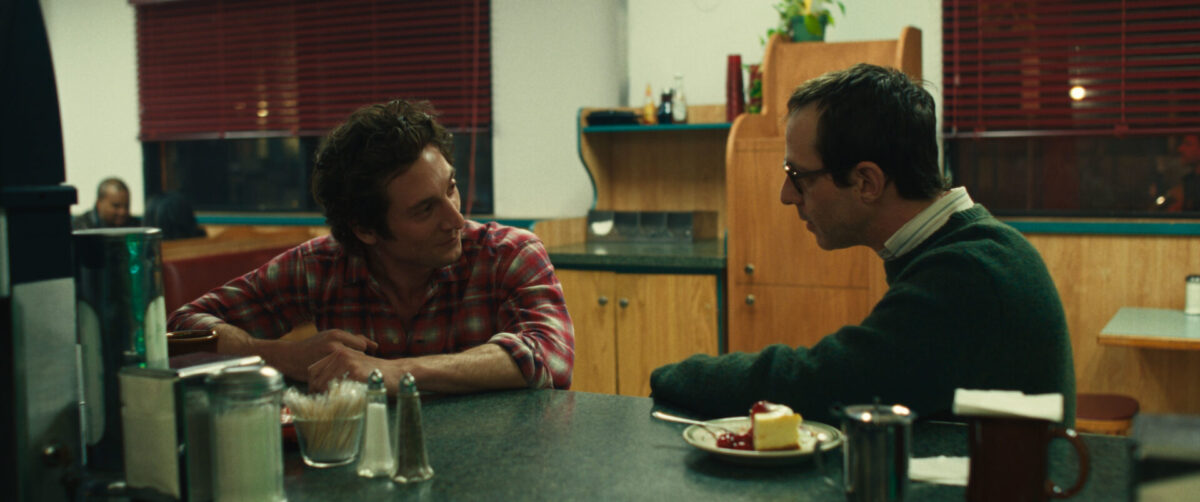
In 1981, Springsteen (fighting fit award-winner Jeremy Allen White) is riding the waves of stardom after a string of hit albums. Springsteen is ending a tour with his band in support of the most recent release, The River, and we see them closing a show with Born to Run. This song of rootlessness and rebellion sets the picture's theme, and, it is suggested the nature of the artist's spiritual journey to wholeness.

Springsteen's manager / producer / confidante / guardian angel Jon Landau (the always-welcome award-winner Jeremy Strong) tells The Boss as he sits alone sweating buckets in his dressing room of upcoming promotional and contractual obligations to Columbia Records. Landau, a vitally perceptive person, senses the reclusive Springsteen is showing road-wear. He acquires a rental home for Springsteen away from the city noise where, it is hoped, Springsteen can decompress and begin work on the next record with a trusted engineer (Paul Walter Hauser).

The 30-year-old Springsteen is feeling more that tour fatigue. He is troubled by recurring memories of his childhood and his battling parents, long-suffering Adele and booze-hound Douglas (Gabby Hoffmann and Emmy-winner Stephen Graham of Adolescence). The memories are driving him into dark spaces and he starts to write songs about anger and meanness and entrapment and escape. 

At the same time, he finds some respite in the company of an old schoolmate's sister, Faye (Odessa Young), and they begin a romance that neither Springsteen nor the audience expects to last because of what emerges from his past.

Cooper follows these two complementary tracks and, intriguingly, takes the story of a talented performer with an outsize public profile and delivers an affective study of the emotional costs of the creative process, the pain and elation of seeing reality first fail and then succeed in meeting one's very personal vision. 

Thursday, October 23, 2025

Roofman


Derek Cianfrance hasn't directed a lot of feature pictures, but he has a sure touch with stories about human imperfection.

I loved both The Place Beyond the Pines (2013) and Blue Valentine (2011), two beautifully unsettling films that starred Ryan Gosling, an apparent Cianfrance muse and creative collaborator, in the roles of damaged men making bad decisions and the women who love them.

The director's latest picture, Roofman, stars Channing Tatum in the true story of Jeff, a handsome and charming but emotionally and financially hobbled veteran in North Carolina, whose inability to provide for his family leads him to burglarize McDonald's restaurants after dark.

After a string of thefts, Jeff is caught by the police and imprisoned. He escapes, learns his wife has filed for divorce and forbids him talking to his children. He takes on a new name, and while on the run, finds shelter in the storage space of a Toys R Us in Charlotte.

He holes up for months, monitoring the doings of staff members, especially the prickly store manager Mitch (Peter Dinklage) and the comely single-mother Leigh (Kirsten Dunst), bathing in the restroom, eating nothing but baby food and chocolate candy.

Through a series of events, Jeff meets Leigh at her church, where he tells everyone he's a government agent on a secret assignment in the city. He needs to keep up this lie until he can get help from a former Army buddy Steve (Lakeith Stanfield) and his girlfriend Michelle (Juno Temple of Ted Lasso) to create new papers so that he can move on with his life.

This presents Jeff with a quandary: he's grown attached to Leigh and her daughters (Lily Collias and Kennedy Moyer) and doesn't want to leave them, but he realizes staying would only lead to his being caught. He makes another series of bad decisions that leads to a stand-off with police and draws the curtain down on his charade.

Tatum and Dunst have an easy rapport so their attraction seems authentic, despite the lunacy of this unlikely adventure. Tatum's bucketfuls of charisma make Jeff an appealing but frustrating mix of survival genius and lunkhead. Still, it's a winning combination that will probably ring true for many audience members who have known a few charming liars in their time and maybe dated a few.

Wednesday, October 22, 2025

After the Hunt


To my mind and eye, director Luca Guadagnino's films are beautifully crafted and edgy (A Bigger Splash, Call Me By Your Name, Bones and All, Challengers, Queer) but are frequently undercut by facile treatment of material he wants audiences to seriously engage. His latest picture, After the Hunt, is representative of the celebrated filmmaker's habit of not fully pulling off an ambitious (and worthy) experiment.

Set in the halls and environs of Yale University -- which, interestingly, is most commonly referred to only as "Yale" -- After the Hunt (which might be referring to the baying of wolves in the wake of a successful kill) concerns a group of self-involved academics who revolve around star philosophy professor Alma Imhoff (Julia Roberts). Her nearest satellites are verbose colleague and frenemy Hank Gibson (Andrew Garfield) and her comparatively taciturn acolyte, Ph.D. student Maggie Resnick (Ayo Edebiri).

Alma is plagued by some mysterious illness, but practically glows with entitlement as she is casually intimidating in the classroom and shimmeringly flirtatious at parties she throws with her doting psychoanalyst / gourmet / provocateur husband Frederik (Michael Stuhlbarg), whom she treats with something marginally better than contempt.

Alma is writer Nora Garrett's wonderful portrait of a detached, over-compensated and entitled intellectual, but Garrett and Guadagnino are not as successful with the rest of the complex cast of characters. Hank is both attractive and repugnant, and Maggie, admirable and pathetic. These contradictions add interesting layers to the story, but the jagged pieces of their personalities don't fit together to provide a full picture.

The intrigue at the center of the film is an accusation of sexual assault raised by Maggie against Hank. The student takes the charge to Alma, who resents being drawn into the mess and wonders, despite her ardent public feminism, if the claims are even true. Audiences have seen Maggie's stalkerish behavior and Hank's rakish tendencies, so anything could be true, and watching these truly unlikable people twist in the wind is interesting for a while, but ultimately it's just depressing.

Monday, September 29, 2025

One Battle After Another


The release of a new Paul Thomas Anderson (PTA) feature film is an event for cinephiles because the decidedly quirky and celebrated auteur has a distinctive narrative style and voice in his movies. He writes and directs dense, often broadly satirical or outrageous stories about damaged people trying to recover from, move past, embrace or benefit from the damage, e.g, The Master (2012), Inherent Vice (2014), Punch-Drunk Love (2002).
That is the thrust of his latest feature, One Battle After Another, which I believe will be listed among the very best of PTA's 10 productions, maybe even moving ahead of Magnolia (1999) and There Will Be Blood (2007).
In Battle, an endlessly watchable Leonardo DiCaprio plays "Ghetto" Cat a/k/a Bob, an explosions expert who hooks up with a revolutionary mob in California called the French 75, which is waging war against the U.S. on behalf of victims of exploitation and oppression, among them immigrants in detention camps and cages.
On his first job, Cat / Bob meets at a detention center the spirited and profane Perfidia Beverly Hills (a scalding hot Teyana Taylor) and they begin a romance, of sorts, shortly after Perfidia coerces at gunpoint a dalliance with the center's commander, Steven Lockjaw (a wonderful Sean Penn), to get his "attention" and his goat. (War is hell!)
Some months pass, Perfidia and Bob are a revolutionary power couple in the Southwest underground, and she gives birth to a daughter, whom she resents. Bob takes over childrearing, and Perfidia presses on with the mission of changing the world. Soon, after a botched bank robbery, the French 75's luck runs out, and they are disbursed. Peridia is captured by Lockjaw, who promises relocation if she give up the names and locations of the others. She does and enters witness protection.
After the 75 is dismantled, Lockjaw is recruited by an underground supremacist group that calls itself the Christmas Adventurers (they greet each other by invoking the name of St. Nick and their secret knock is opening two bars to the chorus for Jingle Bells). They recruit him as an agent of racial purification.
Bob and daughter Charlene / Willa (Chase Infiniti) are in hiding, off-the-grid. Bob does little but smoke weed and lay low. When Lockjaw receives word Bob is still kicking, he dispatches his troops and thus begins the series of "battles" between supremacist eradication, governmental cold efficiency and revolutionary soulfulness.
But this is only one variety of battle depicted in PTA's landscape, which was inspired by Thomas Pynchon's Vineland. The political and the familial are also fighting for which is more important, with the clearest answer being, unironically, both and neither.

Tuesday, September 23, 2025

HIM


TV director Justin Tipping "tackles" professional football in a daring and bloody fashion in HIM, his first major feature film that is more surrealism than horror.
Tyriq Walters stars as Cameron Cade, touted as the best college quarterback in the country, as he travels to New Mexico after a brutal, disabling attack to work with the GOAT, Isaiah White, played by Marlon Wayans, the high-powered QB for the San Antonio Saviors
Cade was reared by his father, Cam Sr. (Don Benjamin) to aspire to be the next Isaiah White, and he cannot decline the chance to work into the post, even if his head injury is a recurring concern.
He arrives at White's compound and is greeted with warm affection by White and his wife, Elsie (Julia Fox) but that quickly turns into intimidation and increasing levels of brutality, made bearable by daily injections and transfusions administered by White's personal physician, Marco (Jim Jefferies).
The script by Tipping and writers/producers Skip Bronkie and Zach Akers pulls from a number of cinematic and cultural traditions. Its religious symbolism and references to denial of self and blood sacrifice brought to mind the films of Spanish surrealist Luis Bunuel. It bears more than a passing resemblance to the work of Jordan Peele, one of the picture's producers.
Though both Wayans and Walters deliver tireless performances (Walters more than Wayans), the story's trajectory feels uncertain, the messaging is muddy and seems to be mostly about the deceptive qualities of ambition than anything else. That is a rich concept to explore, and I hope Tipping gives it another shot.
I suspect HIM will find a cult audience drawn to the movie's physicality, sexual tensions and treatment of sacred cows.

Friday, September 19, 2025

The Long Walk


Stephen King is 77, and he was in his early 30s when he published The Long Walk under the pen name Richard Bachman in 1979. That was way before the current political darkness and threat of social upheaval, but its story fits like a glove.

Francis Lawrence, director of the Hunger Games series, has given masterful shape to King's dystopian tale of teenage boys representing the 50 states in a "walk or die" competition for great wealth and the granting of a single wish to the lone survivor.

The screenplay by King and J.T. Mollner focuses on a dozen or so of the boys, with the friendship between Ray (Cooper Hoffman, son of the late Philip Seymour Hoffman) and Peter (David Jonsson of Alien: Romulus) being the engine behind this grueling and often devastating machine.

The 50 boys, chosen by lottery, gather on a remote Midwestern road, where armed soldiers under the command of The Major (Mark Hamill) wait to escort them on the 300-mile trek. Like competitors in a high school marathon, the boys talk trash to one another, and through this sparring we get to know a bit about each of them, just enough to get us to invest in their fates.

The film's power -- and don't mistake, it is substantial -- lies in what these widely diverse boys reveal about themselves, things that transcend their nightmare world and land squarely in the audience's lap -- and on their hearts.

I put off seeing The Long Walk because I thought its narrative of desperation and death would be too much ... and it nearly is. But it is kept from being unbearably depressing through the performances by Hoffman and Jonsson, mainly. All of the young actors are wonderful.

The bond that Ray and Peter develop, the energy that radiates from their devotion, lifts not only the other boys but the audience as well. It is heartening to see selflessness and sacrifice given such life at a time when it would be far too easy to think we had lost them somewhere down the road.

Downtown Abbey: The Grand Finale


British director Simon Curtis rings down the curtain on the venerable historical drama Downton Abbey with a mix of wistfulness and celebration as one generation passes the torch, reluctantly at first, to their successors. Even for one who has not seen a single episode of this show, the story struck notes of warmth and resilience ... much needed these days.

Set during the time of the great market crash at the end of the '20s, "The Grand Finale" opens with a wonderful tracking shot into a London theater where Noel Coward's Bitter Sweet is being performed, its most enduring number -- I'll See You Again -- being reprised at the close of the last act. The camera pans over the audience -- the peers and aristocrats in their boxes, the commoners in the balcony. All in keeping with British tradition.

In the first few minutes, we are (re)introduced to the main players in Downton's world of class and privilege -- principally Mary Talbot (Michelle Dockery), the elder daughter of Lord and Lady Grantham (Hugh Bonneville and Elizabeth McGovern), the master and mistress of the eponymous estate outside of London, a large property that is struggling financially. Mary, a sharp and decisive woman, is heir apparent to the Grantham legacy but is facing her own personal challenges.

News of Lady Mary's divorce hits the London papers, and she becomes a social pariah, invitations to Grantham parties are declined. Other intrigues unfold as Lady Grantham, American born, welcomes her luckless brother (Paul Giamatti) from the States with troubling news about their family's fortune. He is accompanied by an oily friend, Sambrook (Alessandro Nivola), who has been managing the family's accounts, and who presses the wounded Lady Mary into an intimate encounter.

That is a broad outline of the "upstairs" happenings. Changes are also underway "downstairs," in the kitchen and servants' quarters, where the veterans are preparing to take their leave and retire to what is presumed to be a life of well-earned ease. Mrs. Patmore (Lesley Nicol) is leaving the kitchen in the hands of Daisy Parker (Sophie McShera), a young woman she's thought of as a daughter. Jim Carter's Mr. Carson, the senior butler at Downton, is having a bit more difficulty loosening his grip on a post he's held for decades, but his successor Andy Parker, husband to Daisy, shows great deference and forbearance, even as news of the uncertainty about the house's future filters from above.

The film is about the rigidity of class differences in England, but, I think, it is also about how porous those distinctions were becoming. The relationship between Mary and her maid Anna Bates (Joanne Froggat) is one of the richest and more complex. Mary's reliance on the other woman's support and discretion represents the upper class's long-standing (eternal?) dependence on the working class to give their lives form and structure, recognizing (though not verbally expressing) their deep incapability. This is reflected most pithily in a brief exchange when Grantham tells Carson to tie his bowtie for him as he prepares for a public appearance to which the butler is not invited. (Though I spotted only one person of color in the entire picture, the film's message easily translates to America's history with race and class.)

Grace notes on this theme are added when the trio of actor Guy Dexter (Dominic West), his companion and former Downton servant Thomas Barrow (Robert James-Colllier), and Coward (Arty Froushan) are invited to a Grantham affair where all manner of social convention are teased and in the end capsulized by Coward's performance of Poor Little Rich Girl for Lady Mary and the other guests.

At the time, it would have been a huge "FU" to those who were in a twist about propriety and status, and it has a savory deliciousness even today.

Saturday, September 6, 2025

Fantastic Four: First Steps


Marvel's comic series about four science explorers genetically altered by radiation during a cosmic event is nearly as enigmatic as the X-Men series.

Veteran TV director Matt Shakman's The Fantastic Four: First Steps plays with the comic book's classic puzzlement about differentness and duty and adds in family drama in this story of heroes in an anachronistic '60s world responding to a seemingly invincible existential threat.

Led by the ubiquitous Pedro Pascal as rubberized Reed Richards / Mr. Fantastic, the amiable quartet -- Sue Storm / Invisible Woman (Vanessa Kirby), Ben Grimm / The Thing (The Bear's Eben Moss-Bachrach) and Johnny Storm / Human Torch (Joseph Quinn) -- are media darlings, making regular appearances on television and basking in their hard-earned celebrity. They're an international brand on what is an alternative version of Earth that mixes '60s cultural artifacts with futuristic robotics and aeronautics. (MCU once again tapping the parallel multiverse theme.)

When a silver-coated herald on a surfboard (Ozark's Julia Garner), arrives and announces Galactus, The Devourer (Ralph Ineson) is on his way to gobble up the planet and all of its inhabitants, the Four, including a very pregnant Sue, spring into action.

Shakman and his screenwriters choose not to stage a half-dozen or more loud and long battles between good and evil (I think this was a wise decision, considering the ragtag assortment of superpowers the Four present). Instead, and refreshingly, the movie spends much more time on "science" and "science-y things" and problem-solving, using brains to confront a powerful opponent whose appetite makes him myopic and a bit addled. (One is free to make whatever real-world comparisons one wishes.)

In many ways, First Steps includes familiar elements of Marvel's winning formula -- attractive stars, menacing villain(s) and the punchy kind of banter that fans expect. In addition, and I believe this is a first, the movie gets a valuable assist from an infant who, depending on the ambitions of the MCU brain trust, might be the "herald" of a brand-new generation of bombastic heroics, which, in turn, suggests this franchise might be interminable.

Friday, September 5, 2025

The Roses


Film and television director Jay Roach is a master of calamitous comedy that snarls, slobbers and snaps but is nonetheless delightfully entertaining to those of us who savor bashing battles royale -- Austin Powers, Fockers, Bombshell.

His broadly outrageous remake of 1989's The War of the Roses (Kathleen Turner and Michael Douglas) has been whittled down to just The Roses but has not dropped "the war." In fact, Roach expands the battlefield, amps up the emotional and material destruction and spreads the dysfunction of the central pairing -- icy Ivy and theatrical Theo (Olivia Colman and Benedict Cumberbatch, respectively) -- to their closest associates and friends, each more callous and self-involved than the one before.

Roach serves up a banquet of withholding resentment as Ivy's career as a California celebrity chef rockets and Theo's as a visionary architect crashes to earth, literally. Theo, an unemployable pariah consumed by passive aggression, turns their children into fitness weapons of destruction after Ivy's years of fatty indulgence. It's this dynamic that offers the freshest grace notes to the spirited rancor of domestic intranquility. The airport scene where they send the kids (Hala Finley and Wells Rappaport) off to a sports school in Miami says so much about this family and the connective tissue that they lack.

Unhappiness continues to mount, divorce proceedings are initiated, weapons drawn and the fiery ending, well, inevitable. It's a blast!

Caught Stealing and Relay


Darren Aronofsky and David Mackenzie are competing for Best New York chase film currently playing in the cineplexes.

Aronofsky (The Whale, Black Swan, Requiem for a Dream) is offering an unhinged rock-em sock-em that gives a nod to Martin Scorsese's feverish nightmare in Lower Manhattan, After Hours (1985). In fact, the star of that little-known gem, Griffin Dunne, is a featured player in Aronofsky's latest film, Caught Stealing, which stars Hollywood It Boy Austin Butler as hunky Hank, a battered California baseball player living in Alphabet City a decade before the Twin Towers fell.

Hank is dating a foxy EMT named Yvonne, played by Zoe Kravitz, and is generally hail-fellow-well-met to the down-but-not-out denizens of his hardscrabble neighborhood, including the spiky Brit punker next door named Russ (a sporty Matt Smith of Dr. Who and The Crown).

Russ leaves his beloved feline companion, Buddy, in Hank's care so that Russ might visit his ailing father in London. While away, Russ's flat is visited by Russian bruisers who after being confronted bash Hank, believing he is Russ's cohort in a criminal enterprise. They think he knows the location of a large payout Russ owes them.

A police detective (Regina King) tells Hank that Russ is involved with several groups of mobsters that the police have been monitoring. They need Hank's help shutting the mobs down. Hank's reluctant involvement pulls him into dark waters where he and everyone around him, including Buddy, are targets. He spends most of the movie trying to avoid capture.

The film is described as a dark comedy -- the darkness being the body count and the comedic elements being Hank's preposterous predicament. It mostly works, banking on Butler's cheekbones and chiseled abs.

Directed by David Mackenzie (Hell or High Water), Relay stars Riz Ahmed as an anonymous fixer who goes by the name of Tom. He's part of an organization in New York that parlays deals between whistleblowers and the companies they're prepared to drop a dime on.

Lily James plays Sarah, a biochemical researcher who has documentation that a product about to be released by her former company carries dangerous side-effects for some humans who come in contact with it. She was prepared to go public with her findings but has changed her mind because of the threats she's received.

She wants out, and Tom arranges through an untraceable communication network to coordinate the exchange, secure Sarah's safety and get the company to pay the intermediary $500,000 for making it happen.

Of course, it doesn't happen as planned. Sam Worthington's Dawson and his team try to subvert Tom's plan by intercepting messages so that they might retrieve what was taken and silence Sarah. Tom stays a few steps ahead of Dawson's crew as they crisscross New York City, until forced to improvise by unforeseen complications and turnabouts that some audience members might view as a bridge or two too far in credibility.

Still, Ahmed has an impactful demeanor as he hoofs through the congested alleyways of The Big Apple like a half-back.

Though set in different decades, Caught Stealing and Relay are commenting -- in different ways -- on public and private distrust, heroic loneliness and the elusiveness of enduring happiness.

Eagle Eye

  In 2008, D.J. Caruso directed an AI-gone-rogue thriller that starred real-world PITA Shia LaBeouf and the always welcome Michelle Monaghan...