Saturday, October 25, 2025

Good Fortune


South Carolina's own Aziz Ansari has written and directed a warm and winning comedy that takes the familiar Trading Places device of swapping lives and lifestyles and turns it into a more thoughtful statement on the intersection of social consciousness and the world of work.

Ansari stars as Arj, a luckless drone in the gig economy hive whose despair at ever landing steady employment is overheard by a junior angel named Gabriel (Keanu Reeves), who decides to take on Arj as a project, over the objections of his supervising angel, Martha, played by Sandra Oh

Arj manages to talk his way into a trial position as assistant to a wealthy and oblivious mogul named Jeff (Seth Rogen), who cares for little beyond his own comforts. Though Arj shows initiative and promise, he is fired from the job after using the mogul's company card to pay for dinner with Elena (Keke Palmer) a pretty young stocker in a home improvement store. 

Gabriel believes switching Arj -- who is homeless, living in his car, and showering at a gym -- and Jeff -- who has money to burn -- will benefit both of them. Arj will be more grateful for his own life, and Jeff more sympathetic toward those who have so much less than he. 

The plan doesn't work -- of course -- and Gabriel gets punished by Martha for creating problems when his job was to solve or prevent. As punishment, Gabriel is made mortal and begins his own journal of revelation, which both parallels and diverges from those of Arj and Jeff. 

Ansari's screenplay is clean and clever, his direction sharp and serviceable. Good Fortune is not about flashes of cinematic wonder. Rather, it's about the flashes of recognition that many (most?) moviegoers will experience while watching the characters discover what's important to life -- decency, kindness, consideration, and well-made tacos.

Friday, October 24, 2025

Springsteen: Deliver Me From Nowhere


https://substreammagazine.com/wp-content/uploads/2025/10/dfn-tp-0005_df13f3ae-1200x502.jpeg 

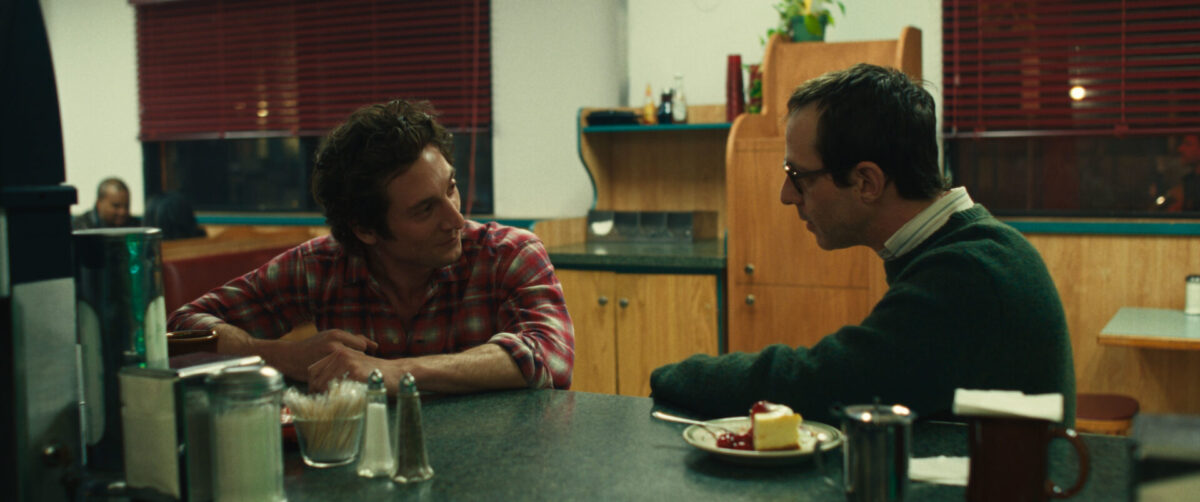
Scott Cooper directs brawny films about headcases with big hearts (Out of the Furnace [2013], Hostiles [2017], The Pale Blue Eye [2022]) and his take on music writer Warren Zane's Deliver Me From Nowhere: The Making of Bruce Springsteen's Nebraska contains those familiar elements wrapped in wonderfully, lyrical moments from a small but important piece of the Boss's life.

In 1981, Springsteen (fighting fit award-winner Jeremy Allen White) is riding the waves of stardom after a string of hit albums. Springsteen is ending a tour with his band in support of the most recent release, The River, and we see them closing a show with Born to Run. This song of rootlessness and rebellion sets the picture's theme, and, it is suggested the nature of the artist's spiritual journey to wholeness.

Springsteen's manager / producer / confidante / guardian angel Jon Landau (the always-welcome award-winner Jeremy Strong) tells The Boss as he sits alone sweating buckets in his dressing room of upcoming promotional and contractual obligations to Columbia Records. Landau, a vitally perceptive person, senses the reclusive Springsteen is showing road-wear. He acquires a rental home for Springsteen away from the city noise where, it is hoped, Springsteen can decompress and begin work on the next record with a trusted engineer (Paul Walter Hauser).

The 30-year-old Springsteen is feeling more that tour fatigue. He is troubled by recurring memories of his childhood and his battling parents, long-suffering Adele and booze-hound Douglas (Gabby Hoffmann and Emmy-winner Stephen Graham of Adolescence). The memories are driving him into dark spaces and he starts to write songs about anger and meanness and entrapment and escape. 

At the same time, he finds some respite in the company of an old schoolmate's sister, Faye (Odessa Young), and they begin a romance that neither Springsteen nor the audience expects to last because of what emerges from his past.

Cooper follows these two complementary tracks and, intriguingly, takes the story of a talented performer with an outsize public profile and delivers an affective study of the emotional costs of the creative process, the pain and elation of seeing reality first fail and then succeed in meeting one's very personal vision. 

Thursday, October 23, 2025

Roofman


Derek Cianfrance hasn't directed a lot of feature pictures, but he has a sure touch with stories about human imperfection.

I loved both The Place Beyond the Pines (2013) and Blue Valentine (2011), two beautifully unsettling films that starred Ryan Gosling, an apparent Cianfrance muse and creative collaborator, in the roles of damaged men making bad decisions and the women who love them.

The director's latest picture, Roofman, stars Channing Tatum in the true story of Jeff, a handsome and charming but emotionally and financially hobbled veteran in North Carolina, whose inability to provide for his family leads him to burglarize McDonald's restaurants after dark.

After a string of thefts, Jeff is caught by the police and imprisoned. He escapes, learns his wife has filed for divorce and forbids him talking to his children. He takes on a new name, and while on the run, finds shelter in the storage space of a Toys R Us in Charlotte.

He holes up for months, monitoring the doings of staff members, especially the prickly store manager Mitch (Peter Dinklage) and the comely single-mother Leigh (Kirsten Dunst), bathing in the restroom, eating nothing but baby food and chocolate candy.

Through a series of events, Jeff meets Leigh at her church, where he tells everyone he's a government agent on a secret assignment in the city. He needs to keep up this lie until he can get help from a former Army buddy Steve (Lakeith Stanfield) and his girlfriend Michelle (Juno Temple of Ted Lasso) to create new papers so that he can move on with his life.

This presents Jeff with a quandary: he's grown attached to Leigh and her daughters (Lily Collias and Kennedy Moyer) and doesn't want to leave them, but he realizes staying would only lead to his being caught. He makes another series of bad decisions that leads to a stand-off with police and draws the curtain down on his charade.

Tatum and Dunst have an easy rapport so their attraction seems authentic, despite the lunacy of this unlikely adventure. Tatum's bucketfuls of charisma make Jeff an appealing but frustrating mix of survival genius and lunkhead. Still, it's a winning combination that will probably ring true for many audience members who have known a few charming liars in their time and maybe dated a few.

Wednesday, October 22, 2025

After the Hunt


To my mind and eye, director Luca Guadagnino's films are beautifully crafted and edgy (A Bigger Splash, Call Me By Your Name, Bones and All, Challengers, Queer) but are frequently undercut by facile treatment of material he wants audiences to seriously engage. His latest picture, After the Hunt, is representative of the celebrated filmmaker's habit of not fully pulling off an ambitious (and worthy) experiment.

Set in the halls and environs of Yale University -- which, interestingly, is most commonly referred to only as "Yale" -- After the Hunt (which might be referring to the baying of wolves in the wake of a successful kill) concerns a group of self-involved academics who revolve around star philosophy professor Alma Imhoff (Julia Roberts). Her nearest satellites are verbose colleague and frenemy Hank Gibson (Andrew Garfield) and her comparatively taciturn acolyte, Ph.D. student Maggie Resnick (Ayo Edebiri).

Alma is plagued by some mysterious illness, but practically glows with entitlement as she is casually intimidating in the classroom and shimmeringly flirtatious at parties she throws with her doting psychoanalyst / gourmet / provocateur husband Frederik (Michael Stuhlbarg), whom she treats with something marginally better than contempt.

Alma is writer Nora Garrett's wonderful portrait of a detached, over-compensated and entitled intellectual, but Garrett and Guadagnino are not as successful with the rest of the complex cast of characters. Hank is both attractive and repugnant, and Maggie, admirable and pathetic. These contradictions add interesting layers to the story, but the jagged pieces of their personalities don't fit together to provide a full picture.

The intrigue at the center of the film is an accusation of sexual assault raised by Maggie against Hank. The student takes the charge to Alma, who resents being drawn into the mess and wonders, despite her ardent public feminism, if the claims are even true. Audiences have seen Maggie's stalkerish behavior and Hank's rakish tendencies, so anything could be true, and watching these truly unlikable people twist in the wind is interesting for a while, but ultimately it's just depressing.

She (1965)

  Back Before the Great Awakening (BGA), Hollywood released a slack spectacle from England's Hammer Studios titled She (1965). The movie...